50 Best Books for Kids Who Just Learned to Read (2025 List)
50 Best Easy Reader Books for Beginners (And Which to Avoid)
What You'll Learn
- Why the books your new reader picks matter way more than you think — and the one trap that sends kids backward
- The difference between decodable books and leveled readers (and why most schools get this wrong)
- 50 easy reader books for beginners, organized by skill level, that our family has actually read and loved
- The single best strategy for building reading confidence — and it's free
Your Kid Can Read. Now the Real Work Starts.
So your kid sounded out their first word. Maybe it was "cat." Maybe it was "dog." Maybe — if you've been drilling like I have — it was "ship" and you nearly cried because they didn't say "boat" while staring at the picture.
Congratulations. I mean that. That's a massive milestone.
But here's what nobody tells you: the period right after a child learns to decode is the most dangerous time in their entire reading development. This is where kids either take off like rockets or stall out completely. And the books you hand them in the next few weeks and months will determine which path they take.
I'm dead serious — this isn't me being dramatic. I've watched this play out four times in my own house.
When my oldest was 5, I made the mistake of handing him a leveled reader from his school's book bin — one of those Fountas & Pinnell aligned texts with predictable sentence patterns and picture cues on every page. He "read" the whole book in three minutes. I was thrilled. Then I covered the pictures with sticky notes and asked him to read it again.
He couldn't get through the first page.
He hadn't been reading. He'd been guessing. And the book was designed to let him guess.
That moment right there — that's when everything changed for me. So by the time my second kid was ready for easy readers, I knew exactly what to look for — and more importantly, what to stay far away from.
The Tiger Truth: What Happens When New Readers Get the Wrong Books
Let me hit you with the numbers real quick, because they're ugly and you need to see them.
Only 33% of 4th graders read at proficient level on the 2022 NAEP — the Nation's Report Card. That means two out of every three kids in America can't read well enough to learn from a textbook. The 2022 NAEP scores showed reading dropped 3 points compared to 2019 — the largest decline in over 30 years.
And here's the part that should honestly scare you: the Annie E. Casey Foundation's 2010 study found that kids who can't read proficiently by 3rd grade are four times more likely to drop out of high school.** Four times.
The 3rd Grade Cliff is real. Kids who can't read by then rarely catch up. And one of the biggest reasons kids stall out is that right after they learn to decode, they get handed books that either teach them to guess — or are so far above their level that they give up.
I was at a playground in Raleigh last spring when another mom told me her son's school had just switched from Lucy Calkins to a Science of Reading curriculum because of North Carolina's HB 521 — the Excellent Public Schools Act. She was confused and honestly a little annoyed. "He was doing just fine before," she told me. I asked if her kid could read the word "splint." He's in second grade. He could not. We sat on that playground bench for twenty minutes while I explained why the switch was happening — Emily Hanford's "Sold a Story" reporting, the NAEP data, the neuroscience showing that unlike spoken language, reading isn't automatic — most brains need explicit instruction to map letters to sounds. She went home and listened to the "Sold a Story" podcast that night. Texted me at 11pm: "I had no idea. Why didn't anyone tell us this sooner?"
That mom's kid had been "reading" leveled readers for two years. Books carefully calibrated so he could guess most words from context and pictures. He looked like a reader. He wasn't one. And the books themselves were part of the problem.
So when I say the books you choose right now matter? I mean they matter like oxygen.
Decodable Books vs. Leveled Readers: Know the Difference
OK, before I hand you the list, you need to understand something that most parents — and honestly, a lot of teachers — don't actually know.
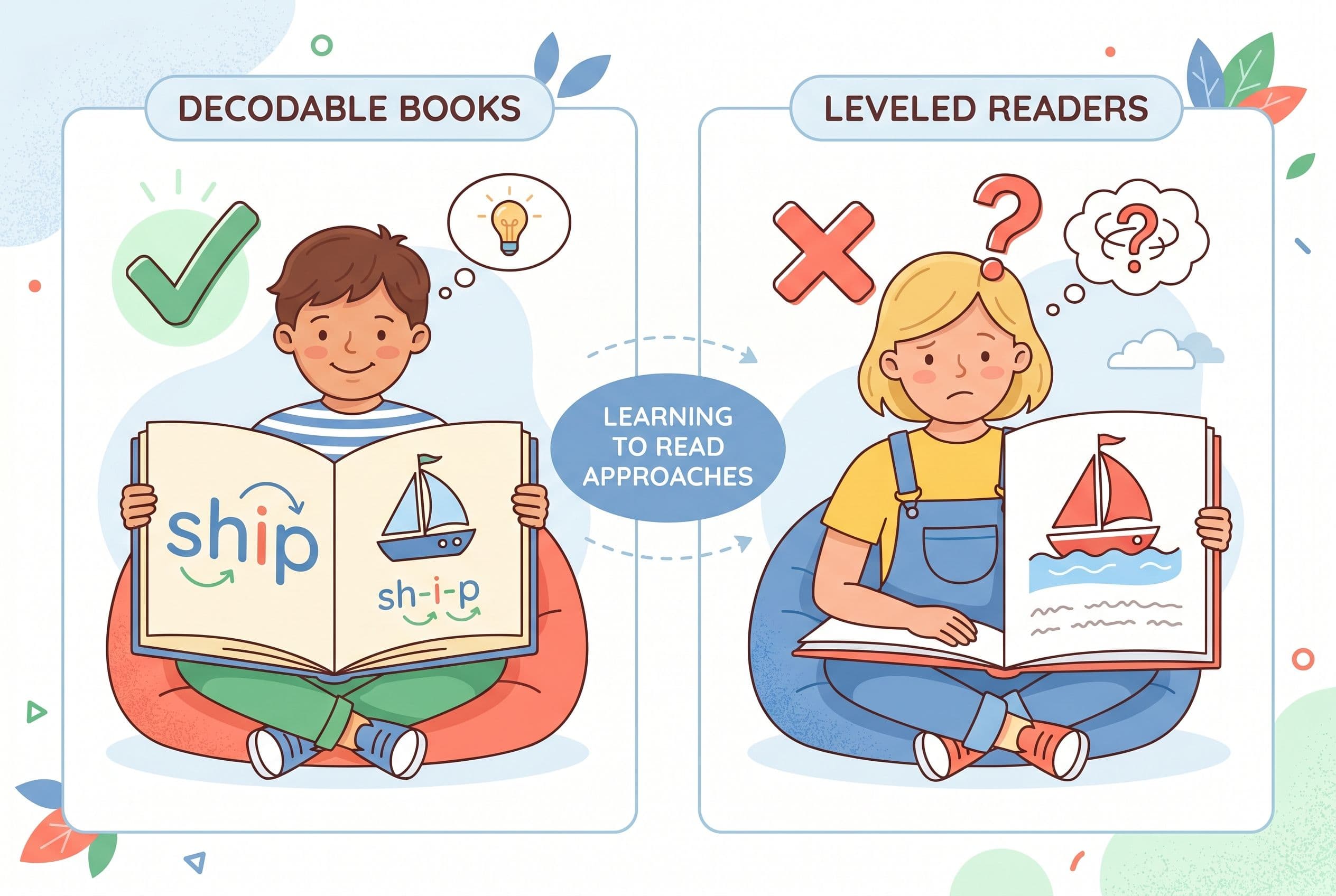
Decodable books are written so that the vast majority of words follow phonics patterns the child has already been taught. If your kid knows short vowels and basic consonants, a decodable book will only use words with those patterns. The child can actually sound out almost every word on the page. No guessing required.
Leveled readers — the ones your school probably sends home in a baggie — are organized by "difficulty" but NOT by phonics patterns. They use predictable sentence structures ("I see a dog. I see a cat. I see a bird.") and rely heavily on pictures so kids can "figure out" words they've never decoded before.
Here's the problem: figuring out a word from a picture isn't reading. It's guessing. And guessing is the exact opposite of what Linnea Ehri's research on orthographic mapping tells us the brain needs to do. Ehri's phases of word reading development (pre-alphabetic, partial alphabetic, full alphabetic, consolidated) show that kids need to map individual graphemes to phonemes — to actually process the letters — to store words permanently in long-term memory. When they guess from pictures, that mapping never happens.
Mark Seidenberg's Language at the Speed of Sight (2017) called this out directly. He's a cognitive scientist at the University of Wisconsin, and he basically said the reading education establishment had been ignoring decades of brain research. The science is clear: kids need to practice decoding real phonics patterns, not memorizing sentence structures.
So here's my rule: for the first 6-12 months after your child starts reading, prioritize decodable books. Once they've mastered the major phonics patterns and can decode unfamiliar words automatically, you can branch out to anything.
Got it? Good. Good — now let's get to the actual books.
The 50 Best Books for Kids Who Just Learned to Read
OK, a couple things before we jump in.
First — the best book is the one that makes your child want to sit down and read. Period. This list is things our kids have loved. Your kid might hate every single one and fall in love with a random book about dump trucks that I've never heard of. Totally fine. That's great, honestly.
Second — the single best thing you can do is go to the library and let your child choose a dozen or more books they want to read. Let them browse. Let them pick based on covers and topics and whatever catches their eye. Then sit with them for the first few pages to make sure they're actually decoding and not guessing or breaking any rules.
Third — I've organized these by skill level, not by age. A 4-year-old who just learned short vowels and a 7-year-old who's behind in reading both need the same type of book. No shame. Just the right tool for the right stage.
OK — let's go.
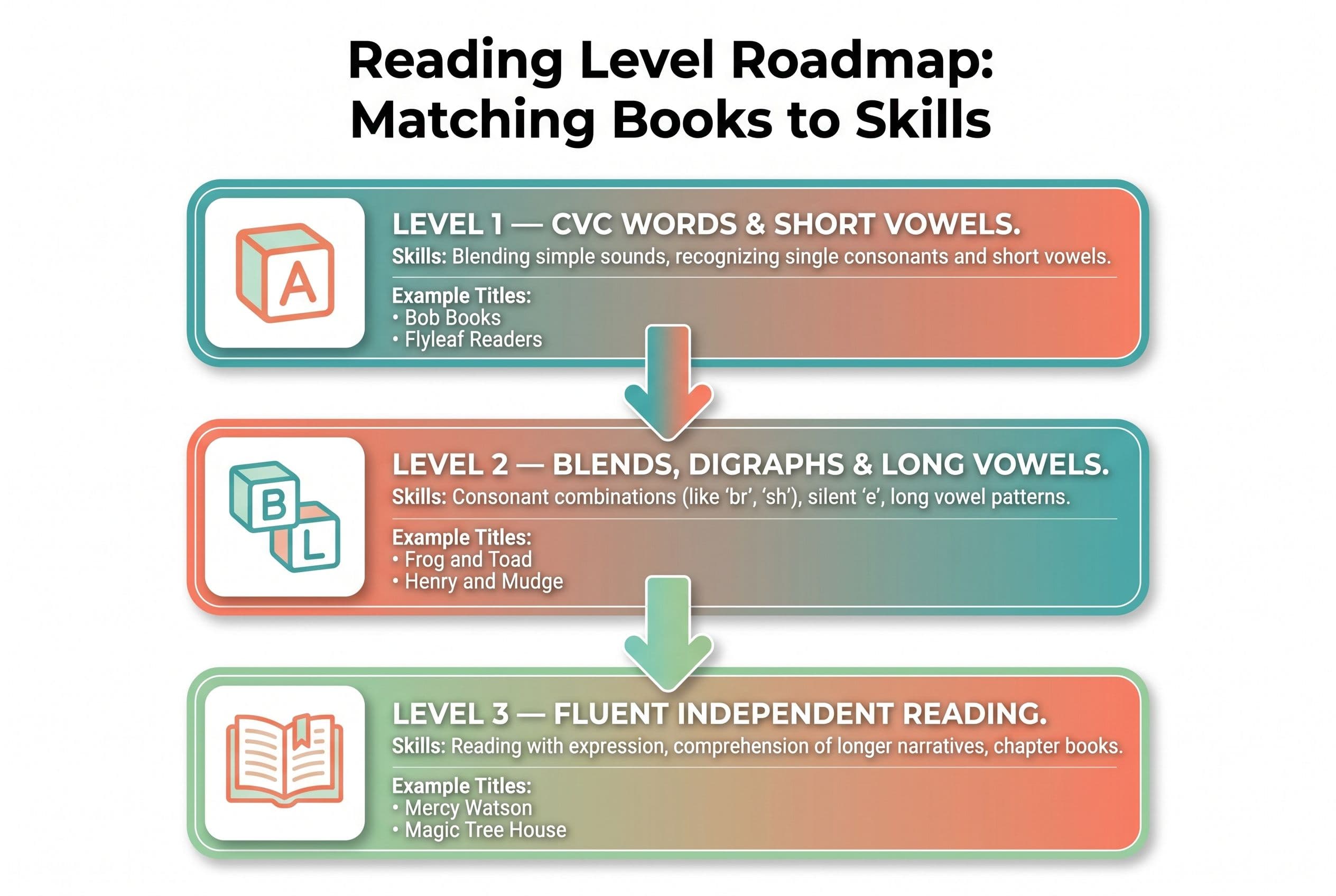
Level 1: Just Starting to Decode (CVC Words, Short Vowels)
These are for kids who know their letter sounds and can blend three-sound words like "cat," "sit," and "hug." If your child is using a program like UFLI Foundations or Fundations, these match roughly the first few units.
-
Bob Books Set 1: Beginning Readers — The OG. Ugly little books with stick figures, and kids love them. My 4-year-old is working through these right now at the kitchen table. Each book uses maybe 6-8 different words, all decodable. They're not winning any design awards, but they work.
-
Bob Books Set 2: Advancing Beginners — Same concept, slightly longer stories, more words per page.
-
Primary Phonics by Barbara Makar (Set 1) — Old school. It's been around since the '90s and it's still kicking for good reason. Short, controlled, decodable. My oldest ripped through these.
-
Flyleaf Publishing Emergent Reader Series — These are the gold standard for decodable readers. Beautiful illustrations (not picture-cue traps — the pictures support the story without giving away words). If your school uses whole-language aligned leveled readers, replace them with these.
-
Dog on a Log Books by Pamela Brooke — Systematically phonics-based, with a scope and sequence that matches Orton-Gillingham progression. Free reading placement tool on her website, too.
-
High Noon Books Sounds Like Reading Series — Originally designed for struggling older readers, but they work beautifully for any beginner. Controlled vocabulary without being babyish.
-
Teach Your Monster to Read (the companion books) — Short, silly, decodable. My 7-year-old thought these were hilarious.
-
I See Sam Readers — Used in a lot of Orton-Gillingham tutoring programs. Very controlled, very systematic.
-
The Reading Reform Foundation Readers — UK-based synthetic phonics readers. Hard to track down, but if you can get your hands on them, they're worth it.
-
Nova's Ark Decodable Readers (Phase 2-3) — Great for kids who know initial consonants and short vowels but aren't ready for blends yet.
Level 2: Building Confidence (Blends, Digraphs, Some Long Vowels)
Your kid can handle words like "ship," "blot," "grub," and is starting to crack long vowel patterns. This is where reading starts to feel real.
-
Bob Books Set 3: Word Families — Introduces rhyming patterns and word families. My second kid got hooked here.
-
Bob Books Set 4: Complex Words — Blends and digraphs. Still short, still manageable.
-
Explode the Code Get Ready, Get Set, Go series — Technically workbooks with reading passages, but the stories are decodable and kids feel accomplished finishing them.
-
The Superkids Reading Program Readers — If your school uses Superkids, you've seen these. Well-controlled, fun characters.
-
Scholastic Decodable Readers (new Science of Reading aligned sets) — Scholastic finally started making real decodable readers. About time.
-
Usborne Phonics Readers — Beautifully illustrated. "Fat Cat on a Mat," "Ted in a Red Bed." My kids loved the rhyming and the art.
-
Dr. Seuss Beginner Books — specifically "Hop on Pop" and "Green Eggs and Ham" — Look, Seuss isn't truly decodable, but these two books use enough phonetic patterns that an early decoder can handle most of the words. They're also genuinely funny, which matters.
-
Little Bear by Else Holmelund Minarik — A classic for a reason. Simple sentences, warm stories, beautiful Maurice Sendak illustrations. Not strictly decodable, but manageable for a kid who's got short vowels and common sight words down.
-
Frog and Toad Are Friends by Arnold Lobel — My all-time favorite easy reader. The stories are genuinely moving. "The Story" chapter where Toad tries to think of a story to tell Frog? It's better than most adult fiction. Not decodable, but perfect for a kid transitioning from decodable to authentic literature.
-
Henry and Mudge series by Cynthia Rylant — A boy and his big dog. Gentle adventures. Manageable vocabulary. My oldest read all 28 books in about two months and cried when they were over.
-
Biscuit series by Alyssa Satin Capucilli — Short, sweet, and about a puppy. My daughter loved these. The "My First I Can Read" level is very accessible.
-
Danny and the Dinosaur by Syd Hoff — Vintage easy reader. Simple plot, repetitive structure, endearing.
-
Mouse Tales by Arnold Lobel — Seven short stories, each about two pages. Papa Mouse tells his seven sons a bedtime story each. Perfect bedtime reading practice.
-
Nate the Great series by Marjorie Weinman Sharmat — Early mystery series. Short chapters, simple vocabulary, and your kid gets to feel like a detective. Real confidence builder.
-
Owl at Home by Arnold Lobel — Yes, another Lobel. The chapter where Owl tries to be friends with the moon? My 7-year-old wouldn't stop talking about it for an entire week.
Level 3: Gaining Fluency (Reading Independently, Ready for Longer Stories)
These are for kids who can decode most one-syllable words without hesitation and are starting to handle multisyllabic words. They're reading in their heads sometimes. They're choosing to read. They're choosing to read on their own. You've arrived.
-
Mercy Watson series by Kate DiCamillo — Hot buttered toast. A pig who loves hot buttered toast. These books are hilarious. Illustrated, short chapters, perfect bridge between easy readers and real chapter books. My son read the first one and immediately demanded the second.
-
Elephant & Piggie series by Mo Willems — Technically "picture books" but they're really dialogue-driven easy readers disguised as picture books. The emotional range in these is wild — funny, sad, philosophical. Gerald and Piggie are better characters than most things on Netflix.
-
The Fly Guy series by Tedd Arnold — A boy and his pet fly. Gross humor that 5-7 year olds find absolutely riveting. Short chapters, accessible vocabulary.
-
Cam Jansen series by David Adler — Mystery series with short chapters. Your kid will feel so smart solving the "case" before Cam does.
-
Magic Tree House series by Mary Pope Osborne — The gateway drug of chapter books. Jack and Annie travel through time. History, adventure, manageable reading level. There are over 60 of these, so once your kid is hooked, you're set for months.
-
Commander Toad series by Jane Yolen — Space adventure parody, pun-heavy, and genuinely funny. Underrated gem.
-
Poppleton series by Cynthia Rylant — A pig who loves libraries and has genteel adventures. Rylant writes with such warmth.
-
Mr. Putter & Tabby series by Cynthia Rylant — An old man and his cat. Quiet, kind, beautifully written. My daughter said these made her want to be old. (I'll take it.)
-
Amelia Bedelia (original series by Peggy Parish) — The literal-minded maid who takes every instruction at face value. These books teach idioms by getting them hilariously wrong.
-
Fox books by Edward Marshall — Short stories about Fox and his friends. Funny, slightly mischievous. Great for reluctant readers.
-
Iris and Walter series by Elissa Haden Guest — Sweet friendship stories. Beautiful language for an easy reader.
-
Pinky and Rex series by James Howe — Best friends navigating the big dramas of being six. Relatable and well-written.
-
Ling & Ting: Not Exactly the Same by Grace Lin — Twin sisters who look alike but are very different. One of the few early readers with Asian-American main characters. My kids saw themselves in these, which matters more than I can tell you.
-
The Princess in Black series by Shannon Hale — A princess who secretly fights monsters. Action, humor, girl power. My daughter read these under the covers with a flashlight.
-
Stink series by Megan McDonald — Judy Moody's little brother gets his own series. Science facts woven into the stories. Funny and informative.
-
Dory Fantasmagory by Abby Hanlon — A younger sibling with a wild imagination. Chaotic, hilarious, and my 7-year-old's comfort read.
-
Houndsley and Catina by James Howe — A dog and a cat who are best friends. Gentle, literary, and beautifully illustrated.
-
Minnie and Moo series by Denys Cazet — Two cows who get into absurd situations. Slapstick humor with actual heart.
-
The Lighthouse Family series by Cynthia Rylant — A cat, a dog, and the animals they rescue. Slightly longer, gorgeous writing. Great transition to independent chapter book reading.
-
Junie B. Jones series by Barbara Park — Controversial in some circles because Junie B. uses incorrect grammar ("runned," "bestest"). I'll be honest — my kids loved these, and the grammar issue never stuck. But if it bugs you, skip them.
-
Ivy + Bean series by Annie Barrows — Two very different girls become best friends. Smart, funny, and the kind of book kids re-read five times.
-
Dragon Masters series by Tracey West — Fantasy adventure with dragons. Chapter books with illustrations on almost every page. Great for kids (especially boys) who need action to stay engaged.
-
Owl Diaries series by Rebecca Elliott — Diary-format chapter books. Eva the owl navigates school and friendship. The format makes pages feel less dense, which is a confidence trick that works.
-
Bad Guys series by Aaron Blabey — Villains trying to be heroes. Heavily illustrated, comic-book style. My son read all 16 in two weeks. Not literary fiction, but the kid was reading for hours voluntarily. I call that a win.
-
Dog Man series by Dav Pilkey — Half dog, half police officer. Graphic novel format. Is this great literature? Nope. Did my son read 800+ pages of it in a month and then pick up "real" chapter books because reading finally felt easy? Yep. Look, sometimes you've gotta meet kids exactly where they are — not where you wish they were.
Why This List Doesn't Matter as Much as You Think
Here's the thing I really want you to hear — and this is the part most "best books" articles skip.
A list can't replace the library.
I've given you 50 books our family has loved. But your kid isn't my kid. Your kid might hate Arnold Lobel and fall in love with a random nonfiction book about volcanoes that's written at a first-grade level. And honestly? A kid who loves volcanoes reading about volcanoes will build more fluency than a kid who hates Frog and Toad slogging through it because some list said to.
The real move? Grab your kid and go to the library. Not the school library during a rushed 20-minute slot — the actual public library on a Saturday morning when there's no rush. Let them wander. Let them pull books off shelves. Let them choose a dozen or more books based on covers and topics and whatever weird thing they're into this week.
Then — and this is the part that matters — sit with them for the first few pages of each book. Make sure they're actually sounding out words, not guessing from pictures. Make sure the book isn't so far above their level that they're frustrated on every line. And make sure they're following the rules: no guessing, sound it out, finger under the word.
So how do you tell if a book's at the right level? Here's the quick test. Have your kid read a page out loud. If they can decode 95% or more of the words accurately on their own, it's a great independent read — let them fly. If they're getting 90-94% right, that's a "read it together" book — sit with them and help when they get stuck. Below 90%? Too hard right now. Save it for later, no shame. And if they're sailing through at 98-100%? Totally fine — don't sweat it. Easy reading builds fluency and confidence, and both of those matter.
I took my 4-year-old to the St. Louis County Library last week — just a random Saturday trip, no agenda. She picked out seven books — three about cats, two about trucks (she contains multitudes), one about a bear, and one about the ocean. Two were too hard. Five were perfect. She read three of them out loud in the car on the drive home — didn't even ask, just started reading. No screen, no app, just a kid who found books she wanted to read.
That right there — that's the whole goal.
How Teach Your Kid to Read Fits In
All these books assume your kid can already decode. That's the foundation — and if it's got cracks, Kilpatrick's orthographic mapping research tells us no amount of great books will patch them.
Teach Your Kid to Read is built on the same systematic synthetic phonics methodology behind programs like Orton-Gillingham and UFLI Foundations. It follows the research — the 2000 National Reading Panel report that Congress commissioned, which found that systematic phonics instruction produces significant benefits for kids in kindergarten through 6th grade. Not just for struggling readers. For everyone.
The app teaches grapheme-phoneme correspondence in a systematic sequence: consonants, short vowels, blending, digraphs, long vowels, r-controlled vowels, and beyond. Every lesson builds on the last. No skipping. No guessing. No pictures to use as crutches.
If your kid is already decoding CVC words, you can start them at the right level and move through the phonics patterns they haven't mastered yet. If they're still at the letter-sound stage, start from the beginning. The app meets them where they are.
And here's the thing about all 50 books on this list — your kid's gonna enjoy them ten times more if they can actually decode the words on the page instead of guessing. (I see this all the time.) Confidence comes from competence. Competence comes from systematic phonics instruction.
Your Action Plan: What to Do This Week
Here's what I need you to do — this week, not "someday." Not next month. This week.
Step 1: Assess where your kid actually is. Can they decode CVC words without guessing? Can they handle blends ("clip," "stop")? Digraphs ("ship," "chop")? If you're not sure, David Kilpatrick's PAST test (Phonological Awareness Screening Test) takes about 5 minutes and tells you exactly where the phonological breakdown is. You can download it for free right now. Use it.
Step 2: Pick 3-5 books from the matching level on this list. If your kid is still on CVC words, start with Level 1. Don't skip ahead because you want them to "feel challenged." Challenge is great. Frustration is not. DIBELS benchmarks suggest 28+ correct letter sounds per minute by mid-kindergarten — if your kid isn't there yet, stay with decodable books.
Step 3: Go to the library this weekend. Bring this list on your phone if you want, but more importantly, let your kid browse. Let them pick what looks interesting. Sit with them for the first few pages. Make sure they're decoding, not guessing.
Step 4: Read every day. Not some days. Every. Single. Day. In our house, we read on birthdays, Christmas, and vacation. That's a Tiger Rule and we don't break it. Fifteen minutes a day of real reading — where your child is actually sounding out words and building fluency — will do more than an hour a week of random "reading time" where they're flipping pages and looking at pictures.
Step 5: If the foundation isn't solid, fix it first. If your child is guessing at words, skipping words, or "reading" by memorizing sentence patterns, they need more phonics instruction before they need more books. That's where our reading programs comes in. Get the decoding foundation right, and books become a joy instead of a battle.
Frequently Asked Questions
How do I figure out if a book is the right level for my new reader?
Forget the Fountas & Pinnell letter levels — those are whole-language aligned and they organize books by predictability, not decodability. Instead, have your kid read a page aloud and count the stumbles. 95% accuracy or higher means they can read it on their own — that's the sweet spot. 90-94% means it's an instructional-level book — read it with them so you can help when they hit a wall. Below 90% means it's too hard right now. Put it on the shelf and circle back in a few weeks — it'll be there when they're ready.
My kid only wants to read graphic novels and comic-style books. Is that "real" reading?
Yep. A kid reading Dog Man is still processing text and building orthographic mapping — the brain doesn't care if the words are in a speech bubble or a paragraph. Just make sure they can actually decode the words — cover a picture occasionally, or have them read a panel out loud — so it's reading and not guessing. Will you want them to branch into prose eventually? Sure. But right now, a kid who reads voluntarily is a kid who's building fluency. Don't kill that by being a book snob. (I say this as a recovering book snob.)
When should I switch from decodable books to "real" books?
When your child can decode unfamiliar one-syllable words automatically — blends, digraphs, long vowels, r-controlled vowels — without stopping to think about the rules. For most kids getting systematic phonics instruction, this happens somewhere between mid-kindergarten and mid-first grade. But there's no magic cutoff. Decodable books and authentic literature can overlap for months.
What if my child hates every book on this list?
Then throw this list out and go to the library. I mean that. Honestly, the best book for your kid is whichever one they'll actually pick up and want to read. Our kids loved these 50 titles, but your kid is a different human with different interests. A kid obsessed with bugs will read a decodable book about bugs with ten times more enthusiasm than a "classic" easy reader about a bear. Follow their curiosity. Just make sure the books match their decoding level.
Should I still read aloud to my child even though they can read on their own?
Absolutely — and don't stop for years. Reading aloud builds vocabulary, background knowledge, and listening comprehension — the other half of Scarborough's Reading Rope that goes way beyond decoding. Read books that are above their independent reading level. Your kid might be decoding CVC words on their own but can understand and love Charlotte's Web read aloud. Those two tracks — independent decoding practice and read-aloud comprehension — should run in parallel.
Xia Brody
Co-Founder, Teach Your Kid to Read
Mom of 4 who has successfully taught her kids to read. Currently in the trenches with her 4-year-old while her two oldest (10 and 7) devour books on their own. Passionate about phonics-based methods and building a lifelong love of reading.