How Much Should a Child Read Each Day? Real Guidelines by Age
What You'll Learn
- The real daily reading minimums by age — and why most online charts get it wrong
- The single biggest mistake parents make that kills a child's desire to read (hint: it's not screen time)
- How to build a house culture where your kid begs to read instead of being forced
- Why "as much as they want" is a better answer than any minute count — and how to actually make that happen
The Question Every Parent Asks (and the Answer Nobody Wants to Hear)
You Googled "how much should a child read each day" looking for a neat little chart. Five minutes at age 4. Ten minutes at age 5. Twenty minutes at age 6.
I get it. I'm a chart person too.
But here's the honest answer: as much as they want to. And if they're older, you can push a bit more. That's it. That's the real guideline.
Now, I know that answer is frustrating. You wanted a number. So I'm going to give you numbers — age-by-age minimums that are backed by research and grounded in what I've seen work across four kids. But I need you to understand something first: the minutes don't matter nearly as much as the culture you build around reading in your home.
I've watched my 10-year-old read for two hours straight on a Saturday because she wanted to finish a book. I've also watched my 7-year-old slam a book shut after 8 minutes because he hit a word he couldn't decode and got frustrated. Same house. Same parents. Same rules. Wildly different reading sessions.
The number on a chart didn't determine who read more that day. The child's skill level, interest, and relationship with reading did.
The Tiger Truth: What Happens When Kids Don't Read Enough
Let me hit you with the scary stuff first, because you need to hear it.
Only 33% of 4th graders read at a proficient level on the 2022 NAEP — that's the Nation's Report Card. One in three. The 2023 scores were even worse, dropping 3 points since 2019 — the largest decline in 30 years.
Kids who can't read well by 3rd grade are four times more likely to drop out of high school. That's from the Annie E. Casey Foundation's 2010 study, and nobody's successfully disputed it since.
And here's the kicker: reading volume — how much a kid reads — is one of the strongest predictors of reading ability. A 1998 study by Cunningham and Stanovich found that kids who read more had larger vocabularies, better reading comprehension, and stronger general knowledge than kids who didn't — even after controlling for IQ. Read that again. Even after controlling for IQ. The kid who reads more gets smarter than the equally smart kid who doesn't read.
But here's the catch most people miss: volume compounds skill after kids can decode accurately enough to actually read. If your child's decoding is shaky, piling on more minutes of "reading" doesn't help — those minutes need to shift toward explicit phonics so that real reading volume becomes possible. (I'll get into this more below.)
So yeah, how much your child reads each day matters. A lot.
But — and this is the part most articles skip — forcing a miserable kid to stare at a page for 20 minutes doesn't count. That's not reading. That's hostage negotiation.
The goal isn't to fill minutes. The goal is to build a reader.
Age-by-Age Reading Time Guidelines (The Real Ones)
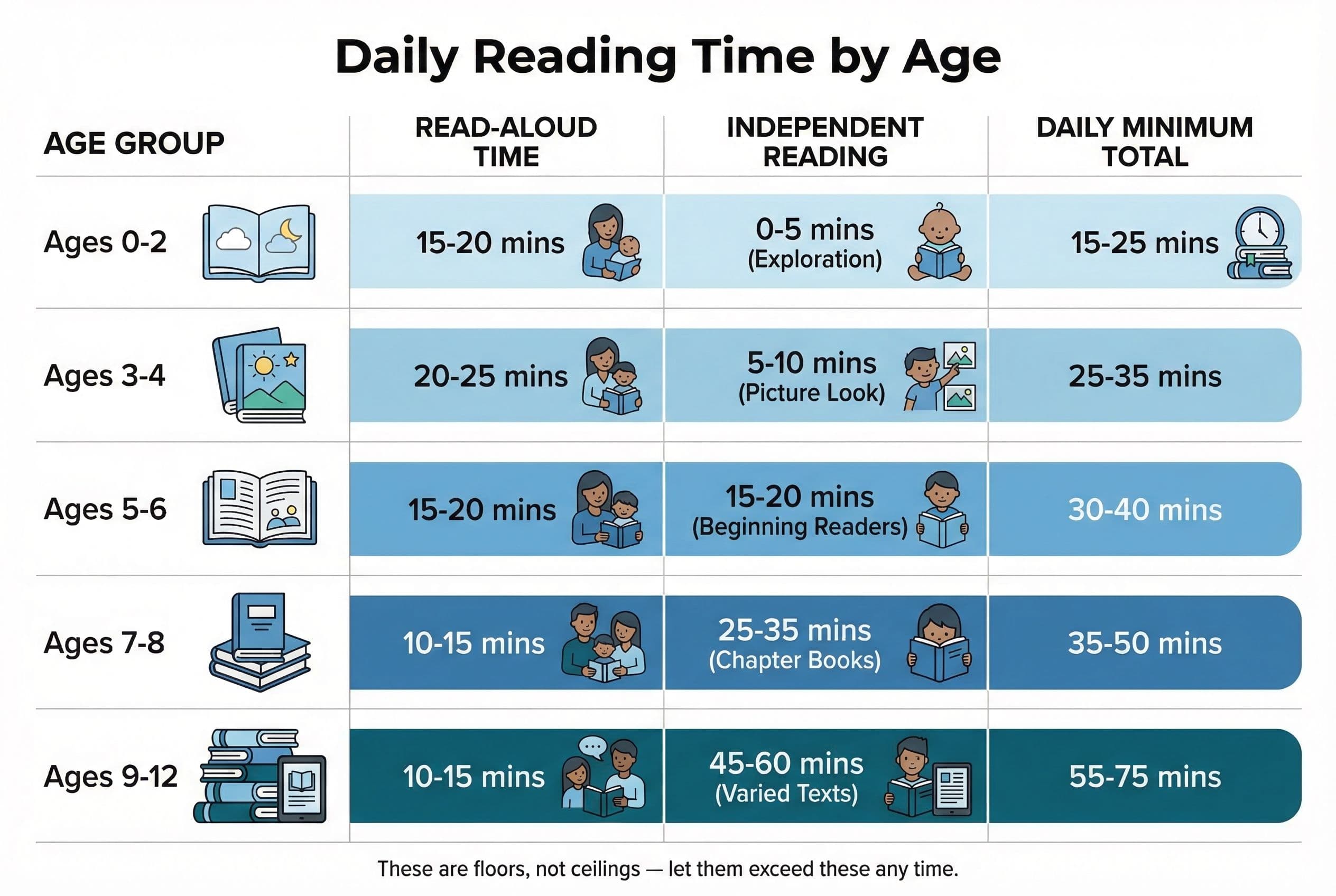
OK, here are the numbers. I'm going to break this into two categories: reading TO your child (which counts enormously and most parents undervalue) and independent reading (which depends heavily on skill level).
Ages 0–2: Read TO Them. A Lot.
- Read-aloud time: 10–20 minutes per day, broken into 2–3 short sessions
- Independent reading: Not applicable (but let them hold board books, flip pages, chew on corners — all good)
My 1-year-old currently has a board book phase where she carries "Brown Bear, Brown Bear" around the house like a security blanket. She can't read a single word. Doesn't matter. She's building the association: books = comfort, books = attention from mom, books = good.
The American Academy of Pediatrics recommends reading aloud starting from birth. Not because a newborn understands plot. Because hearing language builds the neural architecture for reading later. Stanislas Dehaene's research in Reading in the Brain (2009) showed that the brain has to be trained to read — it doesn't happen naturally like speech. The training starts with hearing words. Thousands and thousands of words.
Ages 3–4: Read TO Them More. Introduce Letters.
- Read-aloud time: 15–30 minutes per day
- Phonics/letter practice: 5–10 minutes per day (this is separate from pleasure reading)
- Independent "reading": Let them page through books as long as they want
This is where I am right now with my 4-year-old. We do phonics at the kitchen table every single day — yes, birthdays and holidays included (Tiger Rule #1: We Never Skip). But that's structured practice, not free reading.
For daily reading time? He sits with books constantly. Some days it's 5 minutes. Some days he's on the couch for 30 minutes flipping through a Richard Scarry book, narrating to himself. I don't set a timer. I set up the environment.
Books on every surface. In the car. By his bed. On the bathroom counter (don't judge me). The more accessible books are, the more a 3- or 4-year-old picks them up.
Ages 5–6: The Breakthrough Zone
- Read-aloud time: 15–20 minutes per day (don't stop reading to them just because they're learning to read!)
- Independent reading/phonics practice: 10–20 minutes per day
- Total daily reading exposure: 30–40 minutes
So how long should a 6-year-old read? At minimum, 15–20 minutes of independent reading per day. But here's what I want you to hear: if your 6-year-old wants to read for 45 minutes, let them. Don't cap it. Don't say "OK, that's enough, go play." If a child is choosing to read, you've already won.
At this age, you're looking for kids who can decode CVC words independently (cat, hop, sit) and are starting to blend consonant clusters. DIBELS benchmarks say a mid-kindergartener should hit 28+ correct letter sounds per minute on nonsense word fluency. By end of kindergarten, you're looking at 40+.
If your kid is below those benchmarks, the daily reading time recommendations shift. You need more structured phonics practice (I like UFLI Foundations for this age group) and less "just read for 20 minutes" instruction. Because reading for 20 minutes with poor decoding skills is really just guessing for 20 minutes.
Which brings me to a story.
The Playground Conversation That Changed a Mom's Mind
I was at a playground in Raleigh last year when another mom mentioned her kid's school had just switched from Lucy Calkins to a Science of Reading curriculum. North Carolina's HB 521 — the Excellent Public Schools Act — had forced the change, and she was confused and a little annoyed. "He was doing fine before," she said.
So I asked a simple question: could her kid read the word "splint"? He's in second grade. He could not.
Here's a kid whose daily reading log showed 20 minutes every night. Gold stars from the teacher. "Reading" at home every day. But he wasn't actually decoding — he was guessing from pictures and memorizing patterns. Twenty minutes a day of guessing doesn't build a reader. It builds a kid who looks like a reader until 3rd grade, when the texts get harder and the pictures disappear.
I spent 20 minutes on that bench explaining why the switch was happening — Emily Hanford's APM Reports investigation Sold a Story, the NAEP data, the neuroscience from Dehaene's lab showing the brain doesn't magically learn to read the way it learns to talk. She went home and watched the Sold a Story podcast that night. Texted me at 11pm: "I had no idea. Why didn't anyone tell us this sooner?"
Real talk — the number of minutes your child reads matters way less than what they're doing during those minutes. A kid reading decodable text and sounding out words for 10 focused minutes is getting more out of it than a kid fake-reading a leveled reader for 30.
Ages 7–8: Push a Little More
- Read-aloud time: 15–20 minutes per day (still don't stop!)
- Independent reading: 20–30 minutes per day
- Total daily reading exposure: 40–50 minutes
This is where you can start pushing. Your 7- or 8-year-old should be reading chapter books — even short ones. If they're not there yet, that's your red flag. Get Kilpatrick's PAST test (Phonological Awareness Screening Test) — it takes about 5 minutes and tells you exactly where the phonological breakdown is happening.
My 7-year-old is at this stage. Some nights he reads for 20 minutes and he's done. Other nights he gets sucked into a Dog Man book and I have to physically take it away at bedtime. On the Dog Man nights, I am not complaining. That kid is reading 45+ minutes voluntarily. The goal is more Dog Man nights.
How do you get more Dog Man nights? You don't mandate them. You create the conditions. More on that in a sec.
Ages 9–12: The Volume Sweet Spot
- Read-aloud time: Optional but still hugely beneficial
- Independent reading: 30–45 minutes per day (minimum)
- Total daily reading exposure: 45–60+ minutes
My 10-year-old reads about 45 minutes a day on average. Some days it's 15. Some days it's 2 hours. I don't micromanage it because I don't need to — she's a reader. She sees me read every night before bed. She has a bookshelf in her room that she's proud of. Reading is just what we do in this house.
At this age, the more the better. Cunningham and Stanovich's research showed that the gap between heavy readers and light readers accelerates dramatically between ages 9 and 12. This is the "Matthew Effect" — the reading-rich get richer and the reading-poor fall further behind. Every extra minute of reading at this age compounds.
But — and I can't stress this enough — you cannot force this volume without destroying the love of reading. A kid who reads 30 minutes willingly is building a lifelong habit. A kid who reads 60 minutes resentfully is building a lifelong aversion.
The Real Secret: Build a House Where Reading Is the Norm
OK so here's where I stop giving you minutes and start giving you the actual answer.
How much should a child read each day? As much as they like to.
Your job isn't to set a timer. Your job is to build a home culture where reading happens naturally, constantly, and joyfully. If you do that right, you won't need to ask how many minutes your child should read — because they'll read more than any chart tells them to.
Here's what that looks like in practice:
1. They See You Read
This is the single most powerful thing you can do. Not lecture them about reading. Not buy them books. Not sign up for reading programs. Let them see you read.
My kids see me read every single night. Real books. Physical pages. Not a phone (they can't tell if you're reading or scrolling — and they assume you're scrolling). When my 4-year-old asks what I'm doing, I say, "Reading my book. Want to sit with me and read yours?"
He always says yes.
Kids are mirrors. They don't do what you say. They do what you do.
2. Read TO Them (Way Longer Than You Think You Should)
Most parents stop reading aloud once a kid can read independently. This is a huge mistake.
I still read aloud to my 10- and 7-year-olds. Not because they can't read. Because shared reading builds vocabulary, models fluent expression, and — this is the big one — makes reading a bonding experience instead of a chore.
A kid who associates reading with snuggling on the couch with mom while hearing an exciting story is a kid who picks up books on their own. A kid who associates reading with a mandatory 20-minute timer is a kid who puts the book down the second the timer goes off.
Scarborough's Reading Rope model (2001) shows that reading comprehension depends on BOTH decoding skills AND language comprehension. Reading aloud builds the language comprehension strand — vocabulary, background knowledge, verbal reasoning — even in kids who can't decode yet.
3. Books Everywhere. Literally Everywhere.
I have books in every room of my house. Kitchen counter. Bathroom. Car. Stroller basket. By the front door. Next to the couch.
When a child is bored and a book is within arm's reach, they pick it up. When a child is bored and a book requires walking to a bookshelf in another room? They pick up a crayon or ask for the iPad.
Reduce friction. Make reading the easiest, most accessible activity in your house.
4. Don't Kill the Love
This is where tiger moms need to check themselves. Yes, I'm serious about phonics. Yes, we practice every day. Yes, I have high standards.
But I will never — NEVER — turn reading into punishment.
I don't say "you can't go outside until you read for 20 minutes." I don't take away books as a consequence. I don't force a kid to finish a book they hate. I don't make reading logs feel like homework (and honestly, those school reading logs where kids have to get a parent signature? They train kids to see reading as a compliance task, not a pleasure).
The more you push with a heavy hand, the more you kill the intrinsic motivation. And intrinsic motivation is the only thing that makes a kid read when you're not watching.
But What About Phonics Practice? That's Different.
Let me make an important distinction that most "how much should my child read" articles miss.
Pleasure reading and phonics practice are two different activities. Both matter. But they serve different purposes and have different time recommendations.
Phonics practice (structured, systematic, explicit instruction) is non-negotiable for kids ages 3–7 who are learning to decode. This is the 5–15 minutes of daily drilling — segmenting sounds, blending sounds, mapping graphemes to phonemes. This is the Orton-Gillingham-style work. This is what programs like UFLI Foundations, Fundations, and Logic of English are designed for.
The 2000 National Reading Panel report — the one Congress actually commissioned — found that systematic phonics instruction produces significant benefits for kids in kindergarten through 6th grade. The effect was strongest when instruction was systematic (following a planned sequence) rather than incidental.
Pleasure reading (independent or read-aloud time with books they enjoy) is where volume and love of reading grow. This is the Dog Man on the couch. The bedtime story. The audiobook on a road trip.
You need both. Here's how they break down:
| Age | Phonics Practice (Structured) | Pleasure Reading (Free) | Total Daily Minimum |
|---|---|---|---|
| 3–4 | 5–10 min | As much as they want | 15–30 min |
| 5–6 | 10–15 min | 10–20 min | 25–40 min |
| 7–8 | 5–10 min (if still needed) | 20–30 min | 30–45 min |
| 9–12 | Only if gaps exist | 30–45+ min | 35–50+ min |
Those are minimums. Floors, not ceilings. If your kid wants to blow past them? Let them. Don't you dare interrupt a child who's voluntarily reading.
What "Reading" Counts? (More Than You Think)
Parents ask me this all the time: "Does audiobooks count? Does reading aloud count? What about comic books?"
Yes. Yes. And yes.
Here's what counts as daily reading time:
- Being read to by a parent, sibling, or teacher
- Independent reading of any book, magazine, or printed material
- Audiobooks (these build the language comprehension side of Scarborough's Reading Rope — vocabulary, background knowledge, language structures, and love of story — all of which feed directly into reading comprehension)
- Comic books and graphic novels (Dog Man, Captain Underpants, whatever — a kid reading is a kid reading)
- Decodable readers during practice time
- Re-reading favorite books (this is actually great for building fluency and automaticity — David Kilpatrick's work on orthographic mapping in Equipped for Reading Success (2016) shows that repeated exposure to words builds the permanent memory traces that make reading effortless)
Here's what does NOT count:
- Watching a movie "based on a book"
- Playing reading apps on an iPad where they're mostly tapping and swiping (sorry)
- Staring at a page while actually daydreaming
- Being forced to read while crying
The State of Things: Why This Matters Right Now
Over 40 states have now passed Science of Reading legislation since 2019. Mississippi's Literacy-Based Promotion Act of 2013 took them from 49th to 21st in national reading scores in just 6 years. Colorado's READ Act requires schools to use evidence-based reading instruction. Ohio's Third Grade Reading Guarantee holds kids accountable for reading proficiency.
Schools are finally catching up. But here's what those laws can't do: they can't make your kid read at home.
The at-home reading volume is on you. The daily reading habit is on you. The house culture where books are normal and reading is valued? That's you.
And if your kid is struggling to read — if they're guessing at words instead of decoding them, if they can't sound out "splint" in second grade — then the reading time conversation shifts entirely. You don't need "20 minutes of reading." You need targeted phonics intervention first, so the reading time actually works.
That's where Teach Your Kid to Read comes in. Our program uses systematic synthetic phonics — the same Orton-Gillingham principles behind programs like Wilson Reading System and Barton Reading & Spelling — designed for parents to use at home. No teaching degree required. Just consistency.
The Action Plan: Building a Reading Routine That Actually Sticks
Here's exactly what I'd tell you if you were sitting across from me at a coffee shop:
Step 1: Assess where your kid actually is. Don't guess. If they're 5+, run a quick phonological awareness check. Kilpatrick's PAST test is free, takes about 5 minutes, and tells you exactly where the phonological breakdown is happening. If your school uses DIBELS or PALS (Phonological Awareness Literacy Screening), ask for those scores.
Step 2: Set up the environment before you set a timer. Put books in every room. Let your kid see you read. Read aloud to them every night — even if they're 10. Make reading the default activity in your house, not the assigned one.
Step 3: Start with the minimum for their age (see the chart above) and let them exceed it. The chart is a floor. Not a ceiling. If your 6-year-old reads for 10 minutes one day and 40 the next, both are fine. You're building a habit, not running a factory.
Step 4: Protect the love. If your kid hates a book, let them drop it. If they want to reread the same book 47 times, let them. If they want to read graphic novels exclusively for 3 months, let them. The volume matters more than the genre.
Step 5: Don't skip the phonics. Pleasure reading doesn't replace structured phonics practice for kids who are still learning to decode. Do both. Every day. Tiger Rule #1: We Never Skip.
Step 6: Use the right tools. If your kid is reading independently, make sure they have access to decodable readers at their level — not Fountas & Pinnell leveled readers (those are whole-language aligned and encourage guessing). Look for decodable texts from Flyleaf Publishing or High Noon Books instead.
Bottom Line
How much should a child read each day? As much as they want to — and at least the daily minimum for their age.
But the minutes are not the point. The point is building a home where reading is normal. Where books are everywhere. Where your kid sees you read. Where being read to is a nightly ritual, not a special occasion. Where phonics practice happens every single day so that reading is a skill your child actually has, not one they're faking.
Get the culture right, and the minutes take care of themselves.
Get the skills right — with systematic, explicit phonics instruction — and the minutes become joyful instead of painful.
Do both, and you won't need a chart. You'll need a bigger bookshelf.
Frequently Asked Questions
How many minutes should a 5-year-old read per day?
A 5-year-old should get about 10–15 minutes of independent reading or phonics practice per day, plus 15–20 minutes of being read to by a parent. That's a total of about 25–35 minutes of daily reading exposure. But don't cap it — if they want to keep going, let them. At this age, the phonics practice (decoding CVC words, blending sounds) is just as important as the free reading time. I use that split with my own kids: structured practice first, then we read for fun.
Does reading aloud to my child count as their daily reading time?
Absolutely. Reading aloud to your child is one of the most powerful things you can do for their literacy development. It builds vocabulary, comprehension, and — here's the big one — a love of stories that makes them want to read independently. Scarborough's Reading Rope shows that language comprehension is half of the reading equation. Don't stop reading aloud just because your kid can read on their own. I still read to my 10-year-old, and it's some of the best time we spend together.
My child hates reading. Should I force them to hit the daily minimum?
No. If your child hates reading, forcing them to sit with a book for 20 minutes will make things worse, not better. First, figure out WHY they hate it. If they struggle to decode words, they need phonics intervention — not more time staring at words they can't read. Run a quick assessment like Kilpatrick's PAST test or ask your school for DIBELS scores. If they CAN read but don't want to, the issue is motivation — and that's an environment problem, not a willpower problem. Let them choose their own books (yes, even comic books). Read to them. Let them see YOU read. Build the culture first. The minutes will follow.
Do audiobooks and comic books count toward daily reading time?
Yes, both count. Audiobooks build vocabulary, comprehension, and love of narrative — all of which support reading development. Comic books and graphic novels still require decoding, following a narrative, and building reading stamina. A kid who reads Dog Man for 30 minutes is building real reading skills. Snobbery about "real books" kills reading motivation faster than almost anything else. Let them read what they love.
What's more important — reading time or phonics practice?
Both are essential but they serve different purposes. Phonics practice (systematic, explicit instruction in letter-sound relationships) builds the decoding skills your child needs to read at all. Reading time (independent or read-aloud) builds vocabulary, fluency, comprehension, and the habit of reading. For kids ages 3–7 who are still learning to decode, phonics practice is non-negotiable — even if it's only 10 minutes a day. You can't "read your way" to phonics mastery by guessing. But you also can't build a lifelong reader through drills alone. You need the structured skill-building AND the joyful, voluntary reading time. Do both daily.

Xia Brody
Co-Founder, Teach Your Kid to Read
Mom of 4 who has successfully taught her kids to read. Currently in the trenches with her 4-year-old while her two oldest (10 and 7) devour books on their own. Passionate about phonics-based methods and building a lifelong love of reading.