Reading Assessment for Kids at Home: How to Actually Test Your Child's Reading Level
What You'll Learn
- The one mistake almost every parent makes when testing their child's reading — and why it gives you a completely false picture of their ability
- How to run a real reading assessment for kids at home in under 15 minutes, using techniques that reading specialists actually use
- The specific benchmarks your child should be hitting at each grade level — with real numbers, not vague reassurances
- What to do when the results scare you — because they might, and that's OK
Your Kid Might Not Be Able to Read. Let's Find Out.
Here's the scene I see over and over again. A parent tells me their kid is "doing great" in reading. The school sent home a report card with a smiley face or a "meets expectations" checkmark. The kid can "read" their favorite book out loud — the one they've heard 400 times.
So I hand the kid a book they've never seen before. A decodable reader with words like "clamp" and "drift" and "stench."
Silence.
Or worse — guessing. They look at the picture and say a word that starts with the same letter. They substitute "house" for "home" because it makes sense in context. They skip the hard words entirely and fill in the blank with whatever sounds right.
That's not reading. That's memorization and guessing dressed up in a reading costume.
And here's the kicker — you will never know the difference unless you test them on material they've never seen before. This is the single most important rule for any reading assessment for kids at home: start with a book they've never read. Ideally a series they've never read. Ideally a story packed with new words they have to actually sound out.
I cannot stress this enough. If your kid has heard Goodnight Moon 200 times, they can "read" it to you from memory. That tells you nothing about their decoding ability. Nothing.
The Tiger Truth: What Happens If You Don't Test (And Don't Know)
Let me hit you with the numbers because the numbers don't lie.
Only 33% of 4th graders read at a proficient level on the 2022 NAEP — the Nation's Report Card. That means two out of every three kids in America can't read well enough to learn from a textbook by 4th grade. The 2023 NAEP scores showed reading dropped another 3 points since 2019 — the largest decline in 30 years.
And the Annie E. Casey Foundation's 2010 study found that kids who can't read by the end of 3rd grade are 4 times more likely to drop out of high school.
Four times.
You know what's scarier than those numbers? The fact that most parents of struggling readers don't know their kid is struggling. The school says "he's progressing." The report card says "approaching grade level." The teacher says "she'll catch up."
No. She might not.
Reid Lyon — the NICHD researcher who testified before Congress — said it plainly: 38% of fourth graders can't read at a basic level. Not proficient. Basic. And by the time these kids hit middle school, the cost of remedial reading programs runs $10,000 to $15,000 a year. Insurance doesn't cover it.
So here's my question for you: Do you actually know where your child stands? Not what the school told you. Not what you assume because they can read their favorite picture book. Do you know?
If you don't, keep reading. I'm going to show you exactly how to find out.
Why Most "Reading Tests" at Home Give You Garbage Data
OK so before I walk you through the actual assessment process, let me tell you what NOT to do. Because I see parents making these mistakes constantly.
Mistake #1: Testing with familiar books. I already said this but I'll say it again because it's that important. Your kid's ability to recite The Cat in the Hat from memory is not a reading assessment. It's a party trick. Use unfamiliar material. Always.
Mistake #2: Letting them guess from pictures. If the book has a picture of a dog and your kid says "dog" instead of sounding out the word "pup" — that's not reading. That's Whole Language guessing, and it's the exact methodology that Emily Hanford's 2023 APM Reports investigation Sold a Story exposed as scientifically bankrupt. Cover the pictures if you have to. I'm serious.
Mistake #3: Only testing real words. Here's something only reading specialists know — the best way to check if your kid can actually decode is to test them on nonsense words. Words like "blim" or "stod" or "frup." If they can read those, they're actually decoding. If they can only read real words, they might just be relying on memorization. This is exactly what the DIBELS Nonsense Word Fluency subtest measures, and there's a reason it exists.
Mistake #4: Not checking individual sounds first. Before you even hand them a book, you need to know which phonics sounds they actually know. Can they tell you the sound that "sh" makes? What about "oi"? What about "igh"? If they don't know the individual sounds, they can't blend them into words. Period.
And one more thing — kids get rusty. I've watched this happen with my own children. My 7-year-old went through a stretch where we were traveling a lot and her daily reading slipped for about two weeks. When we got back to it, she stumbled on digraphs she'd had cold a month earlier. Fluency and accuracy with recently learned patterns regress without regular practice — especially for early readers. Even a couple weeks off can make a real difference. Piano, swimming, reading — use it or lose it.
How to Run a Real Reading Assessment for Kids at Home (Step by Step)
Alright. Here's the actual process. This is what I do with my own kids, and it's adapted from techniques that reading specialists and literacy coaches use in clinical settings.
You don't need special training. You don't need expensive materials. You need about 15-20 minutes, a quiet space, and a willingness to see the truth.
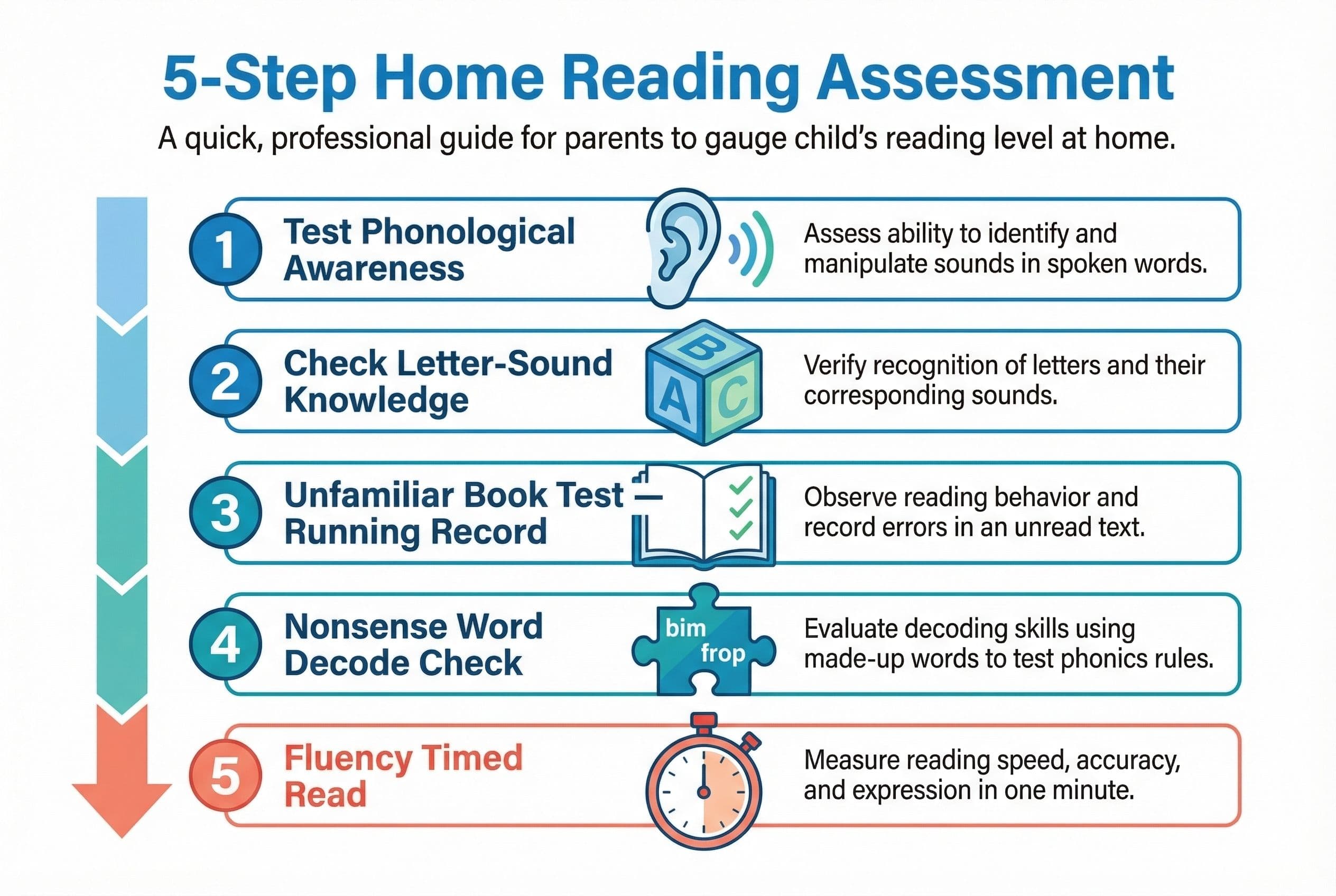
Step 1: Check Their Phonological Awareness First
Before you test reading, test the foundation underneath it. Phonological awareness — the ability to hear and manipulate sounds in spoken language — is one of the strongest early predictors of reading success, right alongside letter-sound knowledge and language comprehension.
Quick definition so we're on the same page: Phonological awareness is the big umbrella — it covers everything from recognizing rhymes to clapping syllables. Phonemic awareness is the advanced level — working with individual sounds (phonemes) — and that's the piece that matters most for decoding. The tasks below start with broader phonological awareness and progress into phonemic awareness, which is where the real reading magic happens.
This is the research behind David Kilpatrick's Equipped for Reading Success (2016), and his work on orthographic mapping explains why some kids memorize words effortlessly while others can't retain anything.
Kilpatrick developed a free screening tool called the PAST — the Phonological Awareness Screening Test. It takes about 5 minutes and tells you exactly where the phonological breakdown is. You can download it free online.
Here's a quick DIY version you can do right now:
- Rhyme recognition (age 3-4): "Do 'cat' and 'hat' rhyme?" If they can't do this by age 4, flag it. (This is phonological awareness.)
- Syllable segmentation (age 4-5): "Clap the parts in 'elephant.'" (el-e-phant = 3 claps) (Still phonological awareness.)
- Initial sound isolation (age 4-5): "What's the first sound in 'map'?" (Answer: /m/) (Now we're into phonemic awareness — individual sounds.)
- Phoneme segmentation (age 5-6): "Tell me all the sounds in 'ship.'" (Answer: /sh/ /i/ /p/ — that's 3 sounds, not 4) (Phonemic awareness.)
- Phoneme manipulation (age 6-7): "Say 'stop' without the /s/." (Answer: "top") (Phonemic awareness — the advanced stuff.)
If your kid can't do the tasks at their age level, that's your answer. You don't even need to test their reading yet. The phonological or phonemic awareness gap is the root problem, and no amount of leveled readers will fix it.
Step 2: Test Their Letter-Sound Knowledge
Grab a piece of paper and write out the alphabet — uppercase and lowercase. But don't just test letter names. Test sounds.
"What sound does this letter make?"
Track which ones they nail instantly (automatic), which ones they get after thinking (hesitant), and which ones they get wrong or don't know at all.
Then test the major digraphs and blends:
- Digraphs: sh, ch, th, wh, ck, ph
- Blends: bl, cl, fl, sl, br, cr, dr, fr, gr, tr, st, sp, sn, sm
- Vowel teams: ai, ay, ee, ea, oa, ow, ou, oi, oy, oo, ue, ew
I keep a simple chart on my fridge — green dot for mastered, yellow for shaky, red for unknown. When I was working with my 4-year-old last week, she had all her single consonant sounds down cold but completely blanked on "wh" and mixed up "b" and "d" (which is totally normal at her age, by the way).
The point is: you need to see which phonic sounds they know, which ones they're struggling with, and which ones they don't know at all. This becomes your teaching roadmap.
Step 3: The Unfamiliar Book Test (a.k.a. The Running Record)
This is the big one. Reading specialists call this a running record — it's a standardized way of listening to a child read and tracking their accuracy, errors, and self-corrections.
Here's the at-home version:
1. Pick the right book. This is non-negotiable: it must be a book they've never read before, from a series they've never read. No familiar characters, no memorized patterns. For kids at the CVC level, grab a decodable reader from the Bob Books series or Flyleaf Publishing decodable texts. For more advanced readers, pick a passage at what you think is their grade level from a book they haven't touched.
Do NOT use a Fountas & Pinnell leveled reader — those are whole-language aligned and often include words kids are expected to "guess" from context. Use decodable readers that require actual phonics knowledge.
2. Have them read aloud. Sit next to them (not across — you want to see the page). Tell them: "Read this out loud to me. If you get stuck on a word, try to sound it out. Don't skip it and don't guess."
3. Track what you hear. On a separate sheet, mark:
- ✓ for every word read correctly
- Write down the actual word they said for every error (substitution)
- Circle any words they skipped
- Note any words they sounded out successfully (even slowly)
- Note any self-corrections (they said it wrong, then fixed it)
4. Count accuracy. Take the total number of words read correctly, divide by total words in the passage, multiply by 100.
These are commonly used guidelines (not carved-in-stone cutoffs — text difficulty and genre matter, so pair these numbers with what you're actually observing):
- 95-100% accuracy = Independent level (this is too easy — move up)
- 90-94% accuracy = Instructional level (this is their sweet spot for learning)
- Below 90% accuracy = Frustration level (too hard — back it down)
Keep in mind: a decodable reader and a grade-level trade book are very different beasts. If your kid scores 92% on a decodable text, that means something different than 92% on a passage full of irregular words. Watch how they're getting words right (decoding vs. guessing) — that matters just as much as the number.
5. Analyze the errors. This is the gold. Don't just count mistakes — categorize them.
- Did they substitute words that look similar? ("house" for "horse") → They're relying on visual similarity, not decoding
- Did they substitute words that make sense in context? ("puppy" for "dog") → They're guessing from meaning, classic Whole Language habit
- Did they struggle with specific phonics patterns? (Every vowel team word was wrong?) → There's your gap
- Did they skip every multisyllabic word? → They don't know how to chunk syllables yet
This analysis tells you more than any standardized test score ever will. You're not just getting a number — you're getting a diagnosis.
Step 4: The Nonsense Word Check
I grabbed this trick from the DIBELS assessment battery, and honestly it's a game-changer for home assessment.
Write out 10-15 nonsense words at your child's approximate level:
CVC level: bim, rop, fud, gat, lem Blends/digraphs: blen, shom, crip, thud, flam Long vowel patterns: boam, treef, mide, sait, plow
Have your kid read them aloud. No context clues. No pictures. No memorization possible.
If they can decode these accurately, they genuinely understand the phonics patterns. If they stare at "blen" like it's ancient Greek, you know the bl- blend and short-e aren't solid yet.
DIBELS benchmarks for nonsense word fluency vary a bit depending on which edition your district uses (DIBELS Next vs. DIBELS 8th Edition), but as a rough guide, kids should hit approximately 28+ correct letter sounds per minute by mid-kindergarten and be reading whole nonsense words (not just isolated sounds) by end of kindergarten. Check the benchmark tables at dibels.uoregon.edu for the exact numbers that match your child's grade and time of year. If your first-grader can't read simple nonsense words at all, that's a red flag you need to act on.
Step 5: Check Fluency (For Kids Who Can Decode)
If your child passes Steps 1-4 — they have phonological awareness, they know their sounds, they can decode unfamiliar words — then you need to check fluency. Because decoding is just the floor. Fluent reading means they decode automatically, quickly, and with expression.
Here are rough oral reading fluency benchmarks (words correct per minute), adapted from the Hasbrouck & Tindal norms that most schools reference:
- End of 1st grade: 60 WCPM (words correct per minute)
- End of 2nd grade: 100 WCPM
- End of 3rd grade: 110 WCPM
- End of 4th grade: 120 WCPM
Time your child reading an unfamiliar, grade-level passage for one minute. Count the words read correctly. Compare to benchmarks.
If they're decoding accurately but reading at a glacial pace — like 30 WCPM in second grade — they need more practice with connected text. Daily reading. Every single day. This is where my Tiger Rule kicks in: We Never Skip. Reading happens on birthdays, holidays, sick days (if they're well enough to watch TV, they're well enough to read for 10 minutes), and vacation.
The Playground Conversation That Changed Everything
I was at a playground in Raleigh last spring when I got into a conversation with another mom. Her son's school had just switched from Lucy Calkins' Units of Study to a Science of Reading curriculum because of North Carolina's HB 521 — the Excellent Public Schools Act. She was confused and honestly a little irritated about the whole thing. "He was doing fine before," she told me.
So I did what I always do. I asked if her kid could read the word "splint." He's in second grade. A second grader should be able to decode a CCVCC word with a consonant blend without breaking a sweat.
He could not.
He stared at it. He tried "split." Then "spit." Then he looked up at his mom for help.
I spent 20 minutes on that playground bench explaining why the switch was happening — Emily Hanford's investigative reporting in Sold a Story, the NAEP data showing two-thirds of American kids can't read proficiently, the neuroscience from Stanislas Dehaene's lab showing that the brain doesn't learn to read naturally the way it learns to speak. Dehaene's book Reading in the Brain (2009) lays it out clearly — reading is an unnatural act. The visual cortex has to be retrained, letter by letter, sound by sound. There's no "reading readiness" fairy that shows up when your kid turns six.
That mom went home and listened to the Sold a Story podcast that night. She texted me at 11pm: "I had no idea. Why didn't anyone tell us this sooner?"
And that's the thing — nobody tells you. The school says your kid is fine. The report card looks normal. But you don't actually know until you sit down and test them on material they've never seen. That mom thought her son was reading. He was guessing. And without that informal reading assessment — just me and a second-grader and the word "splint" on a park bench — she might not have found out until 3rd grade, when the curriculum flips from "learning to read" to "reading to learn" and struggling kids fall off a cliff they rarely climb back up.
So do the test. Today.
What to Do With Your Results
OK, so you've run the assessment. Maybe the results are great. Maybe they're terrifying. Either way, here's your next move.
If they passed everything with flying colors: Don't stop. Keep them reading daily with increasingly challenging material. Move through decodable readers into chapter books. The goal is automaticity — what Linnea Ehri calls the "consolidated alphabetic phase" in her phases of word reading development (from her 2005 meta-analysis). At this stage, kids recognize common letter patterns as chunks and read words almost instantly. That only comes from massive amounts of practice with real text.
If they're shaky on phonics patterns: You've got your roadmap from Step 2. Go back and explicitly teach the sounds they don't know, using a systematic synthetic phonics approach. Programs like UFLI Foundations (free from the University of Florida) or Logic of English give you the exact sequence. Don't skip around — phonics instruction works because it's systematic and cumulative.
If they can't decode unfamiliar words at all: This is your emergency signal. Don't wait. Don't "give it time." The research is crystal clear — Mark Seidenberg's Language at the Speed of Sight (2017) called out the reading education establishment for decades of ignoring the science. Early intervention is everything. Start with a structured program built on Orton-Gillingham principles — Barton Reading & Spelling is excellent for parents to deliver at home, and Wilson Reading System is gold-standard for kids showing dyslexia indicators.
If phonological awareness is the issue: Go back to the foundation. Kilpatrick's Equipped for Reading Success has a complete phonological awareness training sequence you can do in 5-10 minutes a day. The Lindamood-Bell approach (specifically their LiPS program) is also outstanding for building phonemic awareness from scratch.
And remember what I said earlier — once your kid learns a sound or a skill, they have to practice it consistently or it gets rusty fast. I had my 7-year-old reading every single day during summer break while her friends were at the pool. Were there tears? A few. Did she start second grade reading above grade level while classmates who took the summer off had regressed? Absolutely.
We Never Skip.
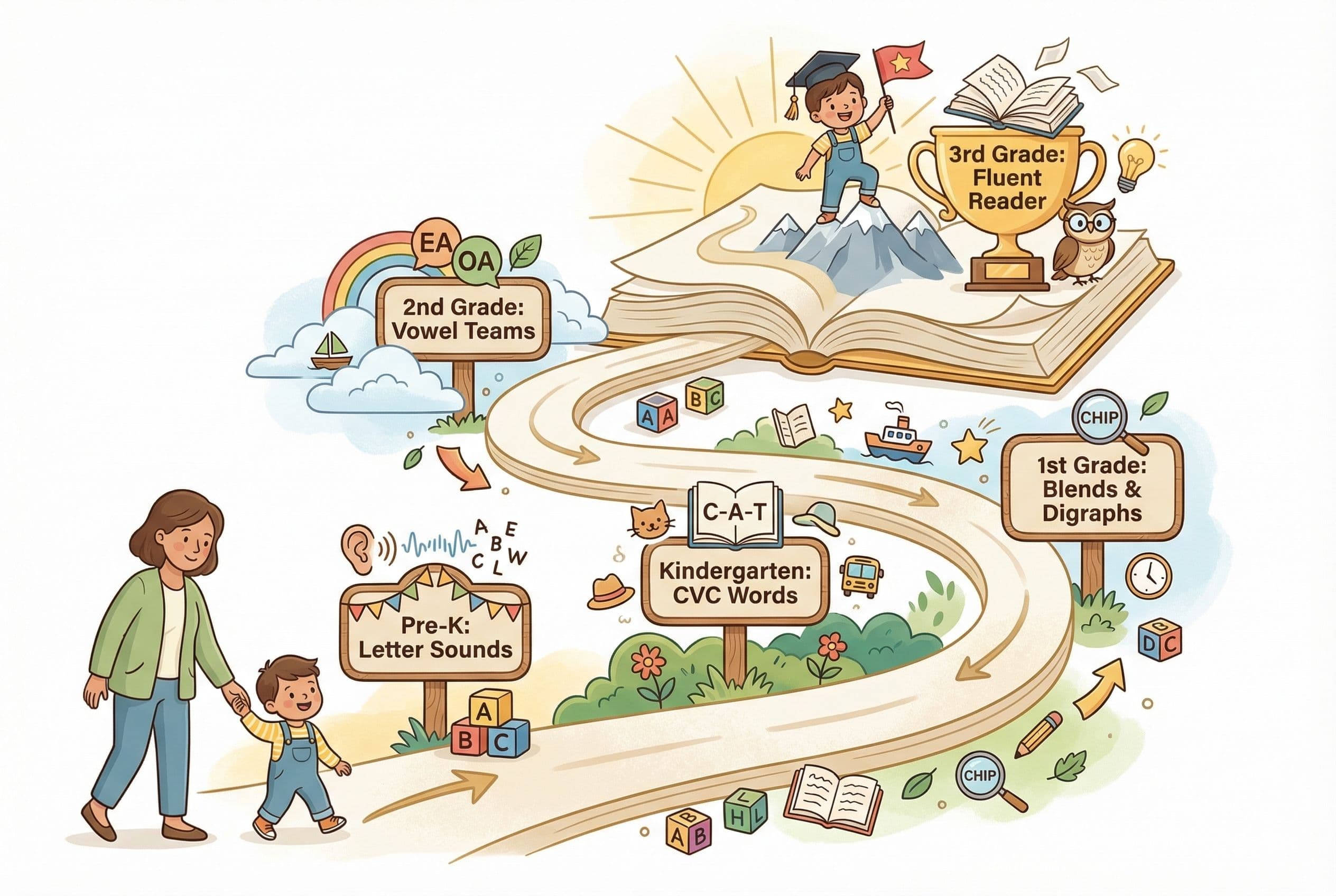
Reading Benchmarks by Grade (Your Quick Reference)
Here's what to look for at each stage. These aren't my opinions — they're based on the DIBELS benchmarks and the Hasbrouck & Tindal oral reading fluency norms that reading researchers use.
Pre-K (ages 3-4):
- Recognizes 10+ uppercase letters
- Can produce rhyming words
- Can clap syllables in spoken words
- Shows interest in books (not a benchmark, but a sign things are on track)
Kindergarten (ages 5-6):
- Knows all 26 letter sounds (not just names — sounds)
- Can segment and blend 3-phoneme words (c-a-t → cat)
- Reads CVC words independently
- DIBELS benchmark: approximately 28+ correct letter sounds per minute on nonsense word fluency by mid-year (check dibels.uoregon.edu for your specific edition)
1st Grade (ages 6-7):
- Decodes consonant blends and digraphs
- Reads words with silent-e pattern (make, ride, hope)
- Reads simple decodable books independently
- Oral reading fluency: 60+ WCPM by end of year
2nd Grade (ages 7-8):
- Decodes vowel teams (rain, boat, seed)
- Reads multisyllabic words with common patterns
- Reads grade-level text with accuracy and some expression
- Oral reading fluency: 100+ WCPM by end of year
3rd Grade (ages 8-9):
- Decodes complex words with prefixes, suffixes, and Latin roots
- Reads chapter books independently
- Comprehends what they read — can retell, summarize, infer
- Oral reading fluency: 110+ WCPM by end of year
If your kid isn't hitting these? That's not a "they'll catch up" situation. That's a "we start working on this today" situation.
Mississippi proved what's possible. After passing the Literacy-Based Promotion Act in 2013, they went from 49th in national reading scores to 21st in just 6 years. They did it with systematic phonics instruction, early screening, and — here's the part most people don't want to hear — holding back kids who couldn't read by 3rd grade. Ohio's Third Grade Reading Guarantee does the same thing. These states stopped pretending and started testing.
You should too.
The Free Tools You Can Use Right Now
You don't need to spend money to check your child's reading level at home. Here's what's available:
- Kilpatrick's PAST test: Free download. Tests phonological awareness across developmental levels. Takes 5 minutes. This is the single best free screening tool available to parents.
- DIBELS assessment: Some versions are available free at dibels.uoregon.edu. The Nonsense Word Fluency and Oral Reading Fluency subtests are the most useful for parents.
- Teach Your Kid to Read: Our app walks you through systematic phonics with built-in progress monitoring, so you always know exactly where your child stands. our reading programs
- San Diego Quick Assessment: A free word-reading test that uses graded word lists from pre-primer through 11th grade. Google it — you'll find printable versions everywhere. Have your kid read the lists until they miss 3+ words at a level. That's their ceiling.
Real talk — the tools exist. The research exists. Over 40 states have now passed Science of Reading legislation since 2019 because the evidence is overwhelming. The only thing missing is a parent willing to sit down, hand their kid an unfamiliar book, and listen to what actually comes out of their mouth.
FAQ: Reading Assessment for Kids at Home
How often should I assess my child's reading at home?
I do a quick informal check every 2-4 weeks — just listening to my kid read an unfamiliar passage and noting accuracy and fluency. A more thorough assessment with phonological awareness screening and sound checks? Every 8-12 weeks, or anytime something feels off. If your child was struggling and you've been doing intervention, check more frequently so you can see what's working.
My child's school says they're at grade level. Should I still test at home?
Yes. A thousand times yes. School assessments often use Fountas & Pinnell leveled reading benchmarks, which allow — even encourage — guessing from context and pictures. A kid can score "on level" on F&P and still not be able to decode the word "splint." I've seen it happen with my own eyes on a playground in Raleigh. Run your own assessment with unfamiliar decodable text and nonsense words. Trust what you find.
What if my child cries or gets frustrated during the assessment?
Stop. Take a break. Come back to it later. But don't abandon the assessment entirely — the frustration itself is data. If a child melts down when asked to read unfamiliar words, that tells you their current reading experience is probably built on memorization and guessing, and they know — on some level — that they can't actually decode. That's painful information, but it's information you need. Be gentle, be calm, but get the information.
Can I use a reading level app or online quiz instead?
Most free "reading level" quizzes online are garbage. They test comprehension of passages the kid reads silently, which tells you nothing about their decoding ability — they might be skipping every hard word and using context to answer questions. The only apps worth your time are ones that test decoding of unfamiliar and nonsense words and track phonics knowledge systematically. That's exactly what we built Teach Your Kid to Read to do. our reading programs
At what age should I start assessing?
Yesterday. OK, realistically — start checking phonological awareness at age 3 (rhyming, syllable clapping). Start checking letter sounds at age 4. Start checking CVC decoding at age 5. The earlier you identify a gap, the easier it is to close. Waiting until "they're ready" is the most dangerous advice in all of parenting. There is no readiness fairy.
The Bottom Line
You are the first line of defense for your child's literacy. Not the school. Not the teacher. Not the report card.
You.
Grab a book your kid has never seen. Sit them down. Listen to them read. Track what you hear. Check their sounds. Test them on nonsense words.
Do it today. Not next week. Not "when things calm down." Today.
Because the 3rd Grade Cliff is real, and the only way to know if your child is headed for it is to actually test them — with unfamiliar material, without pictures to guess from, and without the comfortable lie that they'll figure it out on their own.
And if you want a structured system that does the teaching AND the assessment for you — one that's built on systematic synthetic phonics, tracks your child's mastery of every sound, and never lets them guess — that's exactly what Teach Your Kid to Read is for.
Give your child the reading assessment they deserve. Start now.
Got questions about assessing your child's reading? Reach out to us at (314) 285-9505 or visit contact us today. I read every message — because this stuff matters more than almost anything else you'll do as a parent.

Xia Brody
Co-Founder, Teach Your Kid to Read
Mom of 4 who has successfully taught her kids to read. Currently in the trenches with her 4-year-old while her two oldest (10 and 7) devour books on their own. Passionate about phonics-based methods and building a lifelong love of reading.