Reading Incentive Programs That Actually Work (Without Ruining Books)

The Truth About Reading Incentive Programs for Kids (What Actually Works)
What You'll Learn
- Why most reading incentive programs backfire — and the one psychological trap almost every parent falls into
- The specific reward system I used to get my kids through phonics drills without tears (hint: it involves chocolate and a timer)
- How to transition from external rewards to genuine reading obsession — even with a reluctant reader who'd rather do literally anything else
- The library strategy that took me over a year to crack with my daughter (and why I almost gave up)
The Uncomfortable Truth About Reading Rewards
Here's what nobody tells you about reading incentive programs for kids: most of them teach your child that reading is a punishment you endure to earn a prize.
Think about it. When your kid's school hands out pizza coupons for every 10 books "read," what's the actual message? Reading is so unpleasant that we have to bribe you to do it. That's not motivation. That's a hostage negotiation.
I've homeschooled four kids. My oldest is 10, my youngest is 1, and I'm currently in the thick of it with my 4-year-old. And the single most important thing we focus on when teaching our kids to read — above phonics mastery, above fluency benchmarks, above everything — is making sure they actually love reading.
Not tolerate it. Not comply with it. Love it.
But here's where it gets tricky. Because I'm also a tiger mom who believes phonics practice happens on birthdays, Christmas, and vacation. We never skip. So how do you hold the line on daily practice AND protect the love of books at the same time?
That's what this whole post is about.
The Scare: What Happens When Kids Learn to Hate Reading
Let me hit you with the numbers first, because this isn't abstract.
Only 33% of 4th graders read at proficient level on the 2022 NAEP — that's the Nation's Report Card. Two out of three kids in America can't read well enough to learn from a textbook. The 2023 NAEP scores showed reading dropped another 3 points since 2019, the largest decline in 30 years.
And here's the stat that keeps me up at night: according to the Annie E. Casey Foundation's Double Jeopardy report (2010), students who weren't reading proficiently by 3rd grade had dramatically higher dropout risk — especially kids from low-income families, who were four times more likely to leave school without a diploma.
Now, plenty of those kids can technically decode words. They passed the phonics tests. They read the decodable readers. But somewhere along the way, reading became a chore. They stopped picking up books for fun. They hit the 3rd Grade Cliff — where the curriculum shifts from "learning to read" to "reading to learn" — and they just... didn't have enough fluency, vocabulary, or background knowledge to keep up with harder texts. Some could "sound out" words but weren't truly fluent. Others lacked the language comprehension to make sense of what they were reading. And once reading feels like slogging through mud? Motivation collapses too.
This is the part that bad reading incentive programs make worse. When you over-bribe kids for reading, you get what psychologists call the "overjustification effect." The external reward replaces the internal motivation. Take away the pizza coupon, and the reading stops.
Mark Seidenberg nailed this in Language at the Speed of Sight (2017). He's a cognitive scientist at the University of Wisconsin who spent decades studying how kids learn to read. His argument? The reading education establishment has been so focused on making reading "fun" with gimmicks that they forgot to actually teach the skill. And kids who can't do the skill will never find it fun.
Real talk — you can't love something you're bad at. Nobody enjoys failing.
So step one isn't about rewards at all. It's about making sure your kid can actually read.
First Things First: You Can't Reward What Doesn't Exist
Before we talk about reading incentive charts and reward systems, I need to say something that might sting.
If your child can't decode words accurately and fluently, no incentive program on earth will make them a reader. You're putting the cart before the horse. You're rewarding a kid for pushing a boulder up a hill when what they actually need is someone to teach them how to use a lever.
I watched this play out with my neighbor — a first-grade teacher for 18 years. After Emily Hanford's Sold a Story investigation came out in 2023, she called me almost in tears. She'd been using Lucy Calkins' Units of Study curriculum her entire career. Three-cueing, MSV, the whole guessing-from-pictures approach. She said, "I've been teaching kids to guess for two decades and I didn't even know it."
She switched her classroom to UFLI Foundations mid-year. It was messy. She had to relearn everything herself first — the explicit phonics instruction, the systematic scope and sequence, all of it. But by spring her kids' DIBELS scores had jumped an average of 15 points on nonsense word fluency. She told me that was the first time in her career where every single kid in her class could decode CVC words by February.
Know what happened next? Those kids started voluntarily picking up books during free time. Not because she offered stickers. Not because there was a pizza party. Because they could finally do the thing.
This is what Stanislas Dehaene — he's a French neuroscientist — showed in Reading in the Brain (2009): the brain has to be trained to read. It doesn't happen naturally. Systematic phonics is how you build the decoding circuitry; then practice and reading volume build automaticity. And once decoding isn't painful anymore, enjoyment finally has a chance.
So if your kid is still struggling to decode, stop reading this post and go to our reading programs. Seriously. Get the phonics foundation right first. Then come back here for the reward strategy.
Still here? Good. Let's talk about how to actually do this.
The Xia Brody Reading Reward System (Battle-Tested on 4 Kids)
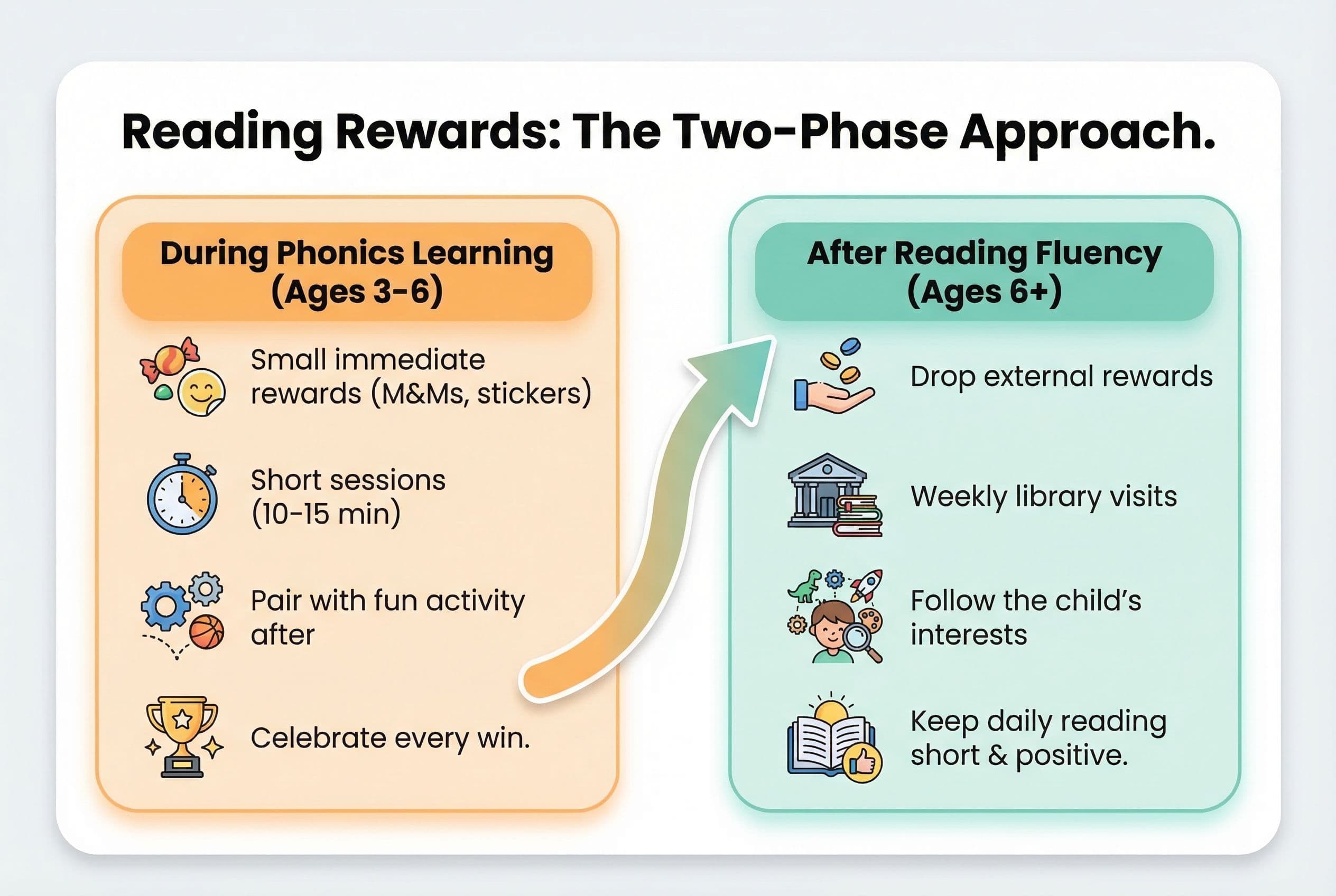
I'm going to break this into two phases, because the reward strategy that works during phonics instruction is totally different from what works once your kid can read independently.
Phase 1: Rewards During Phonics Learning (Ages 3-6ish)
This is the hard part. Phonics drills aren't inherently fun. I don't care what Instagram homeschool moms tell you — blending /sh/ + /i/ + /p/ for the 40th time is not a party.
But it has to happen. Every day. No exceptions.
So here's what we do. We use M&Ms.
Yes, really. M&Ms. I can hear the judgment from the crunchy moms already, and I don't care. Here's the deal — my 4-year-old sits at the kitchen table, we drill letter sounds and CVC blending for 10-15 minutes, and after every few correct answers, she gets an M&M. Sometimes two if she nails a tricky one.
The key is what happens after the lesson. She gets to play a game or have some screen time. That's the bigger reward — the lesson is the ticket to the fun part of the morning.
Here's why this works and most reading incentive charts don't:
1. The reward is immediate. Not "read 20 books and get a toy in six weeks." M&M in the mouth the second she blends the word correctly. Young kids' brains need that instant feedback loop. Before decoding becomes automatic, you need that M&M bridge to keep them engaged long enough for the skill to build. Once it clicks — once blending feels easy instead of effortful — the success itself starts to feel good.
2. The reward is tiny. An M&M is not a pony. It's not even a cookie. It's just enough dopamine to keep a 4-year-old engaged for one more word. You're not creating an entitled monster. You're keeping a preschooler at the table.
3. The session is short. Ten to fifteen minutes. Never longer than that at this age. I make mistakes in a lot of areas as a parent, but this one I got right: never push the phonics session to the point where your kid starts to hate it. Quit while you're ahead. Always.
4. It's paired with something fun. The screen time or game afterward isn't really the reward for reading — it's just the next thing in the routine. But in my kid's brain, phonics time = the thing before fun time. And that association is powerful.
I try to make the lessons fun too. Not every second — some parts are just grinding through letter-sound correspondences, and that's fine. But I use silly voices, I celebrate correct answers like she just scored a touchdown, and I never, ever shame a wrong answer. The vibe is energetic, not clinical.
Will there be frustrating sessions? Absolutely. My 4-year-old had a meltdown last week over the /th/ digraph. I'm not going to pretend every lesson is a Hallmark moment. But the overall feeling about reading time? Positive. That's the goal.
Phase 2: Building a Reading Habit Once They Can Decode (Ages 6-8+)
OK so here's where most parents and most reading incentive programs for kids go completely sideways.
Your child can read. They finished the phonics program. They can decode multi-syllable words. Victory, right?
Not yet.
Because decoding is not the same as wanting to read. And this is the phase where you either create a lifelong reader or a kid who "can read" but never does.
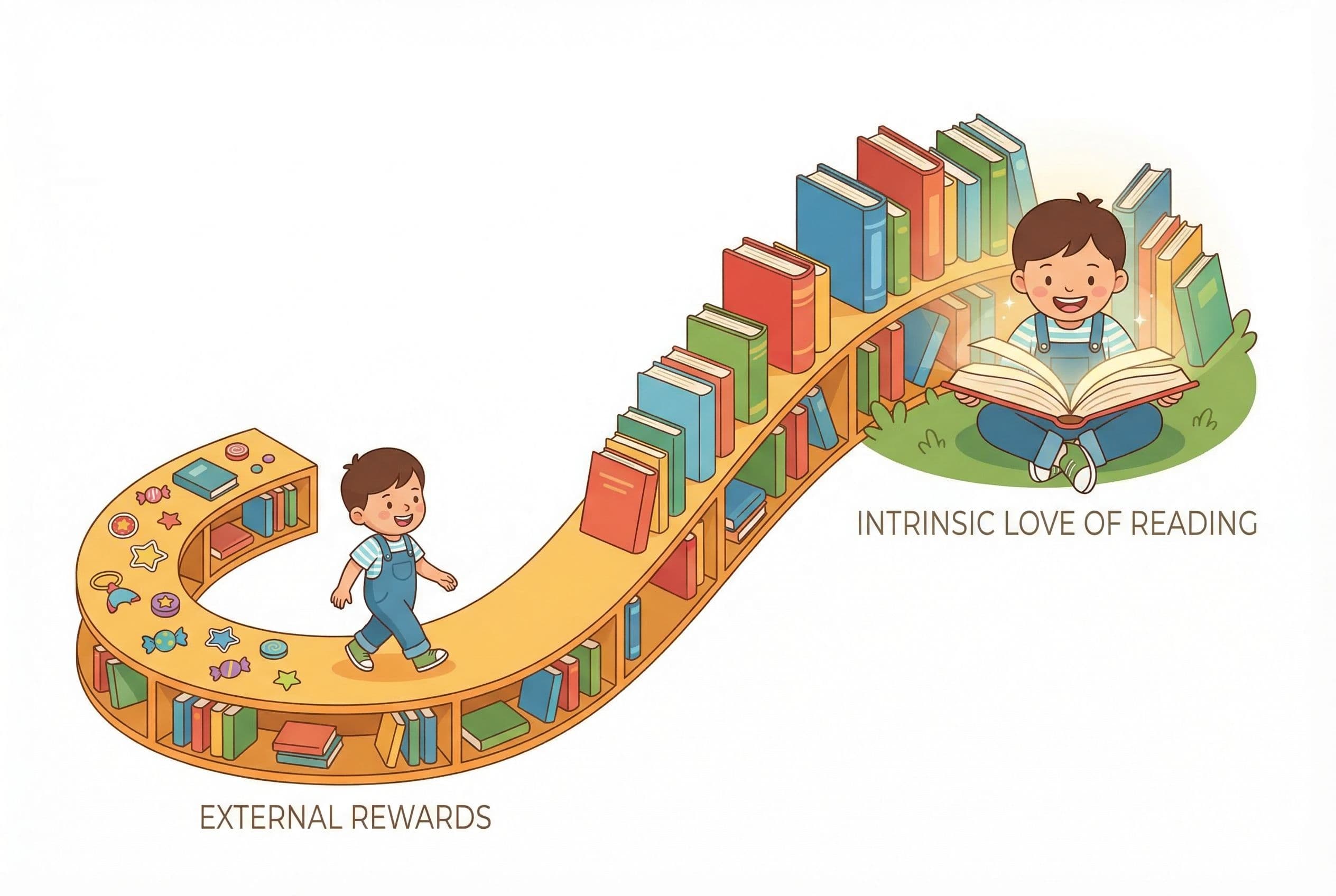
The answer isn't more rewards. It's the right books.
And finding the right books? That can take a really, really long time.
My Oldest: The Easy Win
When my oldest (he's 10 now) finished his phonics instruction and could read independently, we immediately started going to the library every week. Within a few visits, he discovered Geronimo Stilton.
If you don't know Geronimo Stilton — it's a chapter book series about a mouse journalist. The text has crazy fonts, illustrations on every page, and cliffhanger endings. There are over a hundred books in the series.
He was hooked. Instantly. He'd devour two or three a week, then beg to go back to the library for more. We didn't need a reading incentive chart. We didn't need pizza coupons. We just needed to find the right match.
That kid now reads everything. Fantasy, science books, graphic novels, even cookbooks (yes, really). But Geronimo Stilton was the gateway.
My Daughter: The Hard Road
My 7-year-old? Totally different story.
She finished phonics. She could decode beautifully. Her DIBELS scores were solid. But she would not pick up a book for fun. Not Geronimo Stilton. Not Junie B. Jones. Not Dog Man. Not Diary of a Wimpy Kid. Nothing.
We went to the library month after month. I'd pull books off shelves, hand them to her, watch her flip through three pages and put them back. I tried themed reading challenges. I tried letting her pick anything she wanted. I tried audiobooks paired with physical copies.
For over a year, nothing stuck.
I'm not going to lie — there were moments I wanted to just force it. Make her sit and read for 30 minutes whether she liked it or not. Tiger mom instincts were screaming.
But I held back. Because the whole point of all those phonics drills, all those M&Ms, all those morning sessions at the kitchen table — the whole point — was for her to love reading. Forcing a kid to read something she hates for 30 minutes a day is a great way to build a teenager who never touches a book again.
So we kept her daily reading requirement tiny. One or two books. Short ones. Never for too long. Just enough to keep the habit alive without making it feel like punishment.
And then, about two months ago, she found Minecraft books.
Not what I expected. Not what I would have chosen. But comic books about Minecraft, tutorial guides about Minecraft, fiction about Minecraft — she'll sit down and read it. Voluntarily. For fun. She just turned 8, and for the first time, I'm watching her read without being asked.
The kicker? It took over a year of library trips to get there. Over a year of trying and failing. Over a year of me biting my tongue and not forcing chapter books she wasn't interested in.
That's the real reading incentive program, parents. Not sticker charts. Not prize boxes. Finding the book that makes your kid forget they're reading.
Why Most Reading Incentive Programs Fail (And What to Do Instead)
Let's talk about what doesn't work, because I see these everywhere.
The Pizza Hut Book It! Model
Read X books → get free pizza. Sounds great. The problem? Research consistently shows that performance-contingent rewards ("do this, get that") undermine intrinsic motivation for activities that could be enjoyable on their own. Kids start reading for the pizza, not for the story. Remove the pizza, reading drops to zero.
The Accelerated Reader Point Chase
Your kid reads a book, takes a computer quiz, earns points. Schools love this system. But it teaches kids to pick books based on point value, not interest. I've talked to parents whose kids refuse to read anything not "in the system." That's not a reader. That's a points collector.
The Big Prize Reward Chart
"Read 50 books this summer and earn a bicycle!" OK, so what happens on book 51? You need a motorcycle? The escalation problem with big-prize reading incentive charts is real. And kids learn to game the system — picking short, easy books to hit the number.
What Actually Works
Here's what I'd do instead, based on 7 years of teaching my own kids and watching what actually produces lasting reading habits:
1. Keep phonics rewards small, immediate, and temporary. M&Ms, high-fives, a few minutes of screen time after the lesson. Phase them out as the skill becomes automatic. This is a bridge, not a lifestyle.
2. Make the daily reading requirement small enough that it's never a battle. For my reluctant reader, it was one or two short books a day. That's it. I wanted her to close the book thinking "that was fine" — not "thank God that's over."
3. Spend massive time finding the right books. This is the real work. Go to the library every single week. Let your kid wander. Pull things off shelves. Try graphic novels, nonfiction, comics, weird stuff you'd never choose. When you find the match, you'll know — because your kid won't want to stop reading.
4. Never shame their book choices. Minecraft tutorial books? Great. Captain Underpants? Wonderful. A book about monster trucks with 10 words per page? Fantastic. They're reading. They're enjoying it. The "quality literature" can come later.
5. Read aloud to them even after they can read independently. This is a no-brainer that most parents drop too early. Reading aloud exposes kids to vocabulary and stories above their independent reading level. It keeps books associated with warmth, connection, and fun — not worksheets.
Reading Challenge Ideas That Don't Backfire
OK, I know some of you still want a structured reading incentive system. I get it. Structure helps. So here are reading challenge ideas for kids that avoid the traps I just described.
The Genre Bingo Challenge
Make a bingo card with different genres or book types: animal story, biography, graphic novel, book set in another country, funny book, book with a map, etc. The kid crosses them off as they read. The goal isn't a certain NUMBER of books — it's trying new types. The reward for filling the card? A special trip to the bookstore to pick any book they want. (You're rewarding reading... with more reading. See what I did there?)
The Family Reading Challenge
Everyone reads — parents included. Set a family goal for total minutes read each week. Track it on a big chart on the fridge. When the family hits the goal, everyone does something fun together: movie night, ice cream, a park trip. This makes reading a team activity, not a kid obligation.
The "Stay Up Late" Incentive
This one is hands down my kids' favorite. On Friday nights, bedtime is extended by 30 minutes — but only if they're reading in bed. No screens, no games. Just reading. You'd be amazed how "stay up late" reframes reading from "thing I have to do" to "thing I get to do."
The Book Recommendation Wall
Put a whiteboard or corkboard somewhere in the house. After finishing a book, your kid writes or draws a mini-review and posts it. No tracking numbers, no points. Just sharing opinions. My oldest loves this because he gets to tell his younger siblings what to read. It gives him ownership.
The Phonics Foundation Makes Everything Easier
I keep coming back to this because it's true: every single reading incentive program works better when your kid can actually read fluently.
Linnea Ehri's phases of word reading development — from her 2005 meta-analysis — show that kids move from pre-alphabetic (basically guessing) through partial alphabetic, full alphabetic, and finally to consolidated alphabetic, where they recognize word parts automatically. Kids in that consolidated phase read fast, read accurately, and — here's the point — have cognitive energy left over to actually enjoy the story.
Kids stuck in the partial alphabetic phase? Every word is a struggle. They're spending all their brainpower on decoding and have nothing left for comprehension or enjoyment. No reading incentive chart in the world will make that kid love books.
This is exactly why my neighbor's first-graders started choosing books during free time after she switched to UFLI Foundations. She didn't start a new reward system. She just taught them to read properly. The motivation followed the skill.
Mississippi figured this out at a state level. Their Literacy-Based Promotion Act of 2013 required evidence-based reading instruction and early intervention for struggling readers. By NAEP 4th-grade reading scores, they went from one of the lowest-performing states in the country to one of the biggest gainers over the next several years. Not because they got better at bribing kids to read. Because they got better at teaching kids to read.
The Simple View of Reading — that's Gough & Tunmer's 1986 formula — says Reading Comprehension = Decoding × Language Comprehension. If either factor is zero, the product is zero. You can have the richest vocabulary and the best reading reward system for kids in the world, but if decoding is broken, none of it matters.
How Teach Your Kid to Read Fits Into This
This is where I plug our app, and I'm not even going to be subtle about it because I genuinely believe in what we built.
Teach Your Kid to Read uses systematic synthetic phonics based on Orton-Gillingham principles — the same methodology behind programs like Wilson Reading System and Barton Reading & Spelling. It teaches your child to decode in a structured, sequential way so they build real skill, not guessing habits.
And here's why it matters for this conversation about incentives: the app is designed to be short, focused, and rewarding in itself. Lessons are brief enough that you can follow them with your own reward system (M&Ms, screen time, whatever works for your family) without turning reading into a two-hour ordeal.
The faster your kid moves through the decoding phases and reaches fluency, the faster you can stop worrying about rewards and start worrying about finding enough Geronimo Stilton books at the library.
Check it out at our reading programs or call us at (314) 285-9505 if you want to talk through where your child is and what they need.
The Bottom Line: Reward the Process, Protect the Love
Let me sum up what seven years of teaching my own kids to read has taught me about reading incentive programs:
During phonics learning: Use small, immediate rewards. M&Ms, game time, screen time — whatever motivates your specific kid. Keep sessions short. Make it as fun as you can (it won't always be fun, and that's OK). Never skip.
After phonics mastery: Drop the rewards. Shift all your energy to finding books they actually want to read. This might take a week. It might take a year. Keep the daily reading requirement small so it never becomes a fight.
Always: Read aloud to your kids. Model reading yourself. Make books a normal part of your home. Talk about stories at dinner.
The goal was never the sticker chart. The goal was never the pizza coupon. The goal was always a kid who picks up a book because they want to — because reading is something they can do well and something that gives them stories they care about.
That's not a reward system. That's a life skill.
And honestly? The M&Ms were just the bridge to get there.
FAQ: Reading Incentive Programs for Kids
At what age should I start using reading rewards?
I start small rewards (like M&Ms or stickers) as soon as phonics instruction begins — for us that's around age 3 or 4. But keep the rewards tied to effort during lessons, not to reading volume. You're rewarding the work of learning, not creating a transactional relationship with books.
My kid only wants to read "easy" books or graphic novels. Should I push harder material?
Absolutely not. Not yet. If your child is voluntarily reading anything, protect that habit with everything you've got. My daughter reads Minecraft comic books. Not what I'd choose. But she's reading for fun for the first time in her life, and I'm not about to ruin that by forcing Charlotte's Web on her. Let them build the habit first. Complexity comes later.
How long should I expect to use external rewards during phonics instruction?
For most kids, you'll use small external rewards for 6-12 months of active phonics instruction. As their decoding becomes more automatic — around the full alphabetic phase in Linnea Ehri's framework — the success of reading itself starts to become rewarding. You'll notice you can gradually drop the M&Ms without a meltdown. If your kid still needs heavy external motivation after a year of solid phonics instruction, consider getting a reading assessment like Kilpatrick's PAST test to check for phonological processing issues.
Do school-based reading incentive programs (like Accelerated Reader) help or hurt?
It depends on the kid, but I'm generally skeptical. Programs that track books read or points earned tend to create point-chasers, not readers. If your child's school uses one of these, don't fight it — but don't rely on it either. The real reading motivation needs to come from home, from finding books they love.
What if my child hates reading even though they can decode well?
This was my 7-year-old for over a year. She could decode beautifully but wouldn't read for fun. The answer wasn't more rewards or longer reading requirements — it was patience and relentless library visits. Keep the daily reading short (one or two books, never marathon sessions), keep trying different genres and formats, and resist the urge to force it. The match is out there. It just might take a while to find it.

Xia Brody
Co-Founder, Teach Your Kid to Read
Mom of 4 who has successfully taught her kids to read. Currently in the trenches with her 4-year-old while her two oldest (10 and 7) devour books on their own. Passionate about phonics-based methods and building a lifelong love of reading.