What Is Guided Reading? How It Works at Home (Parent Guide)
What You'll Learn
- What guided reading actually is — and the one thing most parents (and teachers) get dead wrong about it
- The difference between guided reading, shared reading, and independent reading — and why mixing them up can stall your kid's progress
- How to run a guided reading session at your kitchen table in 15 minutes, even if you have zero teaching experience
- The non-negotiable skill your child must have before guided reading works — skip it and you're building on sand
The Word "Guided" Is Doing a Lot of Heavy Lifting
Let's get right to it. If you've Googled "what is guided reading," you've probably gotten a pile of jargon about leveled texts, running records, and small-group instruction. That's the classroom version. It's designed for teachers managing 25 kids at once.
You're not managing 25 kids. You've got one. Maybe two. And that changes everything.
Guided reading, stripped down to its bones, means this: You sit next to your child while they read a book that's just slightly harder than what they can handle alone, and you guide them through the tricky parts — not by telling them the answer, but by teaching them how to figure it out.
That's it. That's the whole concept.
But here's where it goes sideways for most families. The way guided reading gets taught in many schools is tangled up with Balanced Literacy, which means kids are encouraged to look at pictures, guess words from context, and skip the ones they don't know. That's not reading. That's a party trick that falls apart by 3rd grade.
Now, a heads-up on terminology: when schools say "guided reading," they usually mean leveled-text coaching with multi-cueing strategies (pictures, context, first letter). What I'm recommending at home is different — it's guided practice with decoding, ideally using decodable books that match the phonics rules you've already taught. Same name, very different approach. When you hear your kid's teacher talk about "guided reading groups," know that it might not look anything like what I'm describing here.
Real guided reading — the kind that actually works — is built on phonics. Your child doesn't guess. They decode. And you're right there making sure of it.
The Reality Check: Why You Can't Outsource This
I talk to parents every week who assume the school has reading covered. They drop their kid off, pick them up, maybe check a folder of worksheets, and figure everything's fine.
Then the 3rd grade reading scores come back.
Here's the ugly truth: according to the National Assessment of Educational Progress, roughly two-thirds of American 4th graders score below proficient on the NAEP reading assessment. Two out of three. And separate longitudinal research — like the well-known study from the Annie E. Casey Foundation — shows that kids who struggle with reading at the end of 3rd grade are far more likely to keep struggling later on. They can catch up with effective intervention, but the odds get worse every year you wait, and most kids don't get that intervention. That's what people mean by the "3rd Grade Cliff" — it's not one single statistic, but a pattern backed by decades of data. And it's real.
So what does this actually mean for your child?
It means you can't just hope the school's guided reading groups are getting the job done. Even in the best classrooms, your kid might get 10-15 minutes of small-group guided reading per week. That's nothing. A kid learning to read needs daily practice — not weekly, not "when we can fit it in." Daily.
And the kicker is, guided reading at home is better than guided reading at school. One-on-one beats small-group every time. You know your kid. You know when they're faking it. You know the difference between their "I'm thinking" face and their "I'm about to guess" face.
That knowledge is your superpower. Use it.
What Happens If You Do Nothing
Let me paint you a picture.
Imagine your kid — let's call him "Marco" — is 5. He's in kindergarten. He seems to be doing fine. He can "read" a few little books by memorizing the patterns. The teacher says he's on track.
Fast forward to 2nd grade. The books get harder. The sentences get longer. There are no more pictures to guess from. Marco starts avoiding reading. He says he hates it. He acts out during reading time. His teacher suggests he might have a "learning difference."
But Marco doesn't have a learning difference. Marco was never taught to decode. He was taught to guess. And now the guessing game is over, and he's got nothing.
This happens every single day in American schools. Not because teachers are bad people — most of them are amazing — but because the system trained them on methods that don't match what the science of reading actually says.
The fix isn't complicated. But it does require you to step up and do the work at home. Every day.
Yes, every day. Birthdays. Christmas. Vacation.
I know that sounds extreme. Trust me on this — it's the boring answer, but it's the real one.
My second kid, Lian, went from zero letter sounds at age 4 to reading simple chapter books by age 6. Not because she's some kind of prodigy — she's not. She's a normal kid who'd rather play with slime than sit still. But we did phonics practice every single day without exception. My husband thought I'd lost it. Other parents at the park would shoot me looks when I'd pull out flashcards while the kids were on the swings.
Lian's 7 now and reads for actual fun. Like, she'll curl up with a book on the couch instead of asking for the iPad. Every parent who side-eyed me at the park has since texted me asking how I did it. The answer is boring: consistency. Every. Single. Day. That's it. That's the secret.
Guided Reading vs. Shared Reading vs. Independent Reading — Know the Difference
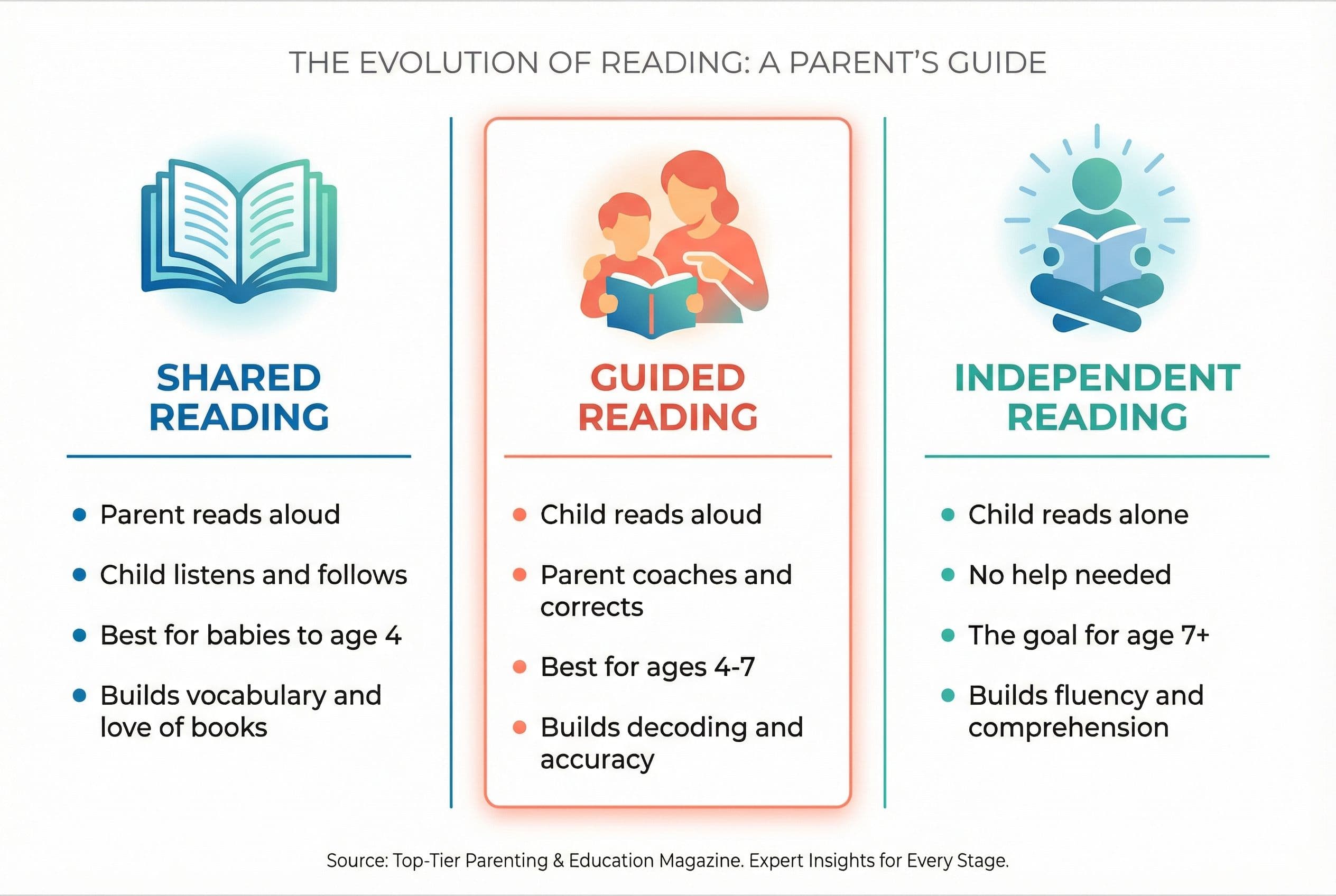
Parents mix these up constantly, and it matters because each one serves a different purpose. Here's the breakdown:
Shared Reading: You read the book. Your child watches, listens, follows along. This is what you do with babies, toddlers, and pre-readers. You're modeling fluency, building vocabulary, and (this is huge) making books part of your kid's daily life. I started reading to all four of my kids before they could sit up. My 1-year-old currently tries to eat the board books, and that's fine — she's still absorbing language.
Guided Reading: Your child reads the book. You sit right next to them, listening, prompting, correcting, and teaching in real-time. The book should be at their "instructional level" — hard enough to challenge them, easy enough that they're not drowning. Think 90-95% accuracy. If they're getting fewer than 9 out of 10 words right, the book is too hard.
Independent Reading: Your child reads alone. No help. This is the goal — the endgame. But a kid isn't ready for truly independent reading until they've put in serious time at the guided level. Handing a struggling reader a book and saying "go read" is like throwing a kid in the deep end before swim lessons.
Real talk — most parents skip straight from shared reading to independent reading and wonder why their kid stalls out. The guided reading phase is where the real skill-building happens. It's where you catch the guessing, drill the phonics rules, and build the decoding muscle.
Don't skip it.
How Guided Reading Actually Works (The Phonics Way)
OK so here's where I'm going to get specific, because I'm tired of blog posts that explain what guided reading is without telling you how to do it at your kitchen table.
Before we start: your child needs to know their letter sounds before guided reading makes any sense. Not letter names — letter sounds. If your kid can sing the ABC song but can't tell you what sound the letter "m" makes, you're not ready for guided reading yet. Go back and drill those sounds. Use flashcards. Use our app at Teach Your Kid to Read our reading programs. It walks you through every sound, in order, with built-in review so your kid isn't forgetting what they learned last week.
Review is everything. I can't stress this enough. Kids forget fast. If you teach the "sh" digraph on Monday and don't revisit it until the following Monday, it's gone. Our app handles this automatically — it cycles back through previous lessons — but if you're doing it yourself, build review into every single session.
Now. Here's how to run guided reading at home:
Step 1: Pick the Right Book
The book should be slightly above what your child can read independently. If they can read it perfectly with zero help, it's too easy (fine for independent reading time, but not for guided practice). If they're stuck on every other word, it's too hard.
Important: look for decodable readers, not just any "early reader" or "leveled book." Most leveled readers at the library (Levels A through E especially) are pattern books full of words your kid can't actually sound out — words like "ocean," "laugh," or "through." If you hand your child one of those books and tell them to sound it out, they'll fail, and it won't be their fault. Decodable readers are specifically written so the words match phonics rules your child has already learned. Ask your librarian for "decodable readers" or "phonics readers" by name. Check the pages before you check them out — if the words follow rules your kid knows, you're good. If every other word is an exception, put it back.
Go to the library regularly. I take my kids every week. Let them pick books they're excited about, even if they can't read them yet — those go in the "read to me" pile. Then you pick 1-2 decodable books at their instructional level for guided practice.
Step 2: Do a Quick Book Introduction (30 Seconds)
Flip through the pages together. Talk about what the book might be about. Point out any tricky words you know they'll hit. But do not pre-read the book to them. The whole point is for them to do the reading.
Step 3: They Read, You Listen
Your child reads out loud. You sit close enough to see the page and follow along. Keep your mouth shut unless they need help. This is their time to practice the skill.
Step 4: When They Get Stuck, Don't Give Them the Word
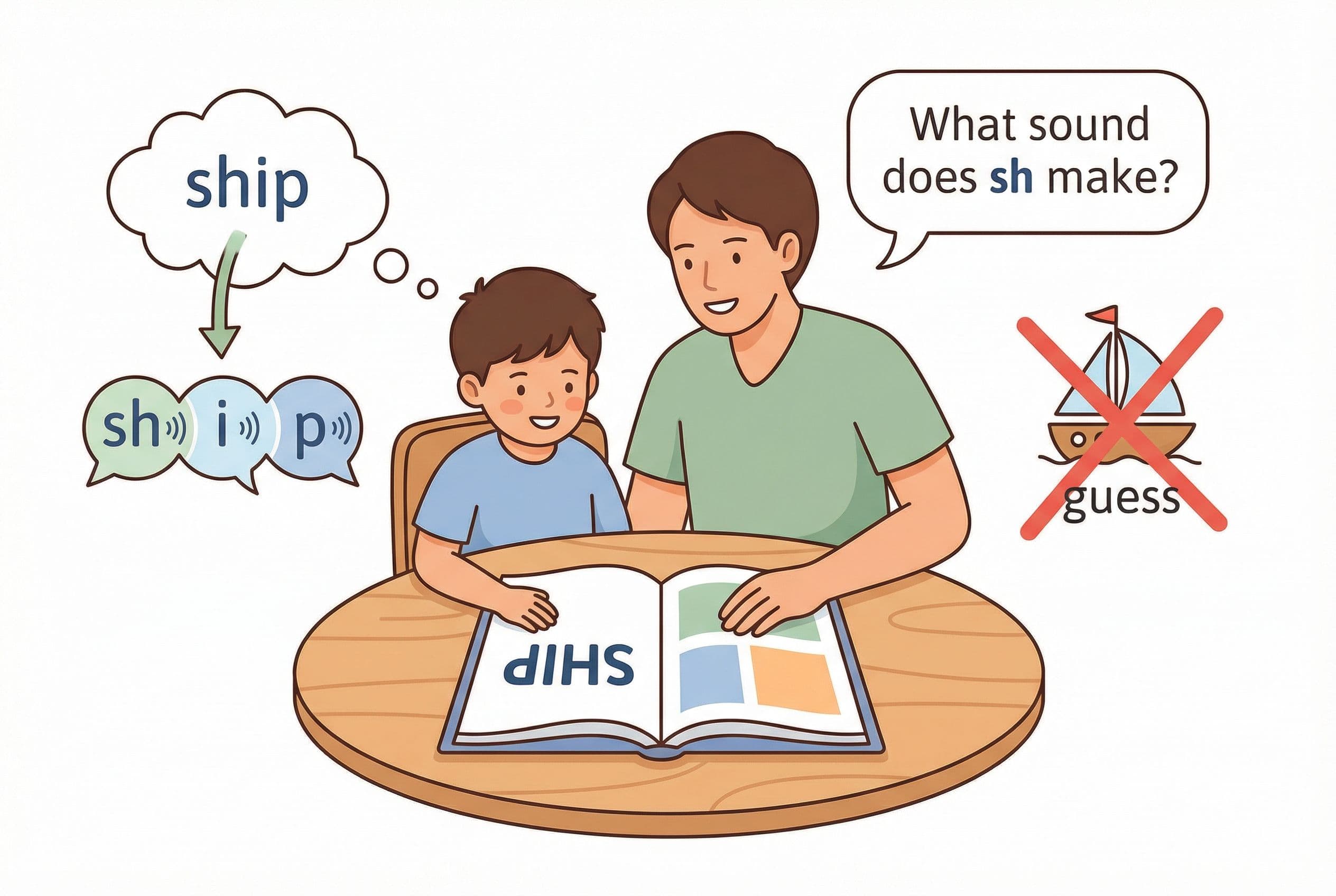
This is the non-negotiable. When your kid hits a word they don't know, do not tell them what it says. Instead:
- Say: "Sound it out. What's the first sound?"
- If it's a word with a rule they know (like silent e, or a digraph), remind them: "What does 'th' say?"
- If it's a word with a rule they haven't learned yet, teach it right there. "That's a new one — when you see 'igh,' it says /ī/."
- Letters first, always. If they look at the picture and say a random word, gently redirect: "Don't look at the picture. Look at the letters. What do they say?" Once they've sounded the word out, then they can check the picture or the sentence to confirm it makes sense. That's how it works — decode first, then use context to verify. But context is never the starting point.
Step 5: After They Finish, Talk About What They Read
Ask one or two questions. "What happened in that story?" "What was your favorite part?" This builds comprehension and shows your kid that reading isn't just decoding words — it's understanding ideas.
Step 6: Do It Again Tomorrow
Bottom line: the session takes 15 minutes. Sometimes 10. That's it. But you do it every day. Not three days a week. Not when you feel like it. Every day. Consistency plus the right method — explicit phonics and daily practice — is the combo that actually produces readers. Not curriculum. Not intelligence. Not how many educational toys you own. Consistency with the right approach.
Understanding Guided Reading Levels (Without Overthinking It)
You'll hear a lot about guided reading levels — letters from A to Z, with A being the easiest and Z being advanced middle school. The system was created by Fountas and Pinnell, and schools use it to sort kids into groups.
Here's my honest take: the leveling system can be useful as a rough guide, but parents obsess over it way too much.
What matters isn't whether your kid is on "Level E" or "Level G." What matters is:
- Can they decode the words on the page using phonics? (Not guessing. Not memorizing. Decoding.)
- Are they reading with reasonable accuracy? (90-95% at the guided level)
- Are they understanding what they read?
If the answer to all three is yes, they're at the right level. If they're guessing, struggling with more than 1 in 10 words, or can't tell you what happened in the story — adjust.
Don't get hung up on the letter. Focus on the skill.
Guided Reading Activities That Actually Build Mastery
I get asked about guided reading activities a lot, and I'll be blunt — most of the "activities" you find on Pinterest are arts and crafts disguised as reading instruction. Your kid does not need to build a diorama of a book they read. They need to practice decoding.
Here are activities that actually move the needle:
Before reading:
- Review phonics rules you've recently taught. Quick drill — 2 minutes. Flashcards, whiteboard, or our app our reading programs. The review piece is non-negotiable. If they learned "oa" says /ō/ last week, quiz them on it today.
- Preview 3-5 tricky words from the book. Have your child sound them out before they encounter them in context.
During reading:
- Track accuracy. Note which words they struggle with — those go on a "practice" list.
- If they self-correct (they say the wrong word, then fix it), praise that. Self-correction is a sign the decoding machinery is working.
After reading:
- Re-read the same book. Seriously. Re-reading builds fluency and confidence. Most parents move to a new book too fast. Read the same one 2-3 times across different days.
- Have them read their favorite page to a sibling, a stuffed animal, a grandparent on FaceTime. Performing what they've read reinforces fluency.
- Use the tricky words from the session in everyday life. If "through" was hard, point it out on a road sign the next day. Show your child that reading is everywhere — on cereal boxes, menus, street signs, text messages. Make reading a visible, constant part of your family's life, and it becomes a visible, constant part of theirs.
The Biggest Mistake Parents Make With Guided Reading
You ready for it?
They let their kid guess.
Imagine this: your child is reading a book about a dog. They hit the word "fetch" and they're stuck. They look at the picture — there's a dog with a ball. They say "catch."
And you say... "Close enough! Keep going!"
No. Stop. That's not reading. That's guessing. And every time you let it slide, you're training your child to use pictures and context as a crutch instead of actually looking at the letters on the page.
I know it feels harsh to stop them. I know it kills the flow. But the flow doesn't matter right now. Accuracy matters. Decoding matters. The flow comes later, once the foundation is rock-solid.
My tiger rule: Letters first, always. Sound it out. Every time. Once they've decoded the word, they can glance at the picture or re-read the sentence to check — "Does that make sense?" That's fine. That's actually good reading. But the letters come first, not the picture. If they can't sound it out because they don't know the phonics rule yet, that's your cue to teach it. That's the "guided" part of guided reading.
Making Reading Part of Your Life (Not Just a "Lesson")
Here's something I wish someone had told me when I started teaching my oldest to read: the 15-minute guided reading session is the minimum, not the ceiling.
The families whose kids become strong readers aren't just doing daily lessons. They're living in a reading-rich environment. Here's what that looks like in our house:
- Library trips every week. Not occasionally. Every week. My kids each pick 5-10 books. Some are way above their level (those go in the "read to me" pile). Some are easy favorites. The point is, books are always circulating.
- Reading is visible. I read in front of my kids. My husband reads in front of them. They see us choosing books over phones. Monkey see, monkey do.
- Words are everywhere. I point out words on signs, menus, packaging. My 4-year-old sounded out "EXIT" at Target last week and almost fell over with excitement. That moment? Worth more than any worksheet.
- Bedtime stories are sacred. We read aloud every night. Even to the 10-year-old. Even when I'm exhausted. Even on Christmas. This is shared reading — it builds vocabulary, comprehension, and a love of stories that makes guided reading feel worth the effort.
The goal is to make reading so normal in your home that your kid doesn't think of it as a "thing they have to do." It's just... what your family does. Like eating dinner or brushing teeth.
How Teach Your Kid to Read Fits Into All of This
Look, I built Teach Your Kid to Read our reading programs because I was doing this stuff manually with my first two kids and realized most parents don't know where to start. What phonics rules to teach. What order to teach them in. How to build in the review that keeps kids from forgetting.
The app walks you through it step by step — letter sounds, blending, CVC words, digraphs, vowel teams, all of it. In order. With review built in so you're not scrambling to remember what you covered last week.
But here's what I want to be clear about: the app doesn't replace you. It's not a "hand your kid an iPad and walk away" situation. You sit with your child. You guide them. You're the teacher — the app is your lesson plan.
That's the whole philosophy. Parent-guided, phonics-based, consistent daily practice. No guessing. No shortcuts. Just the boring, repetitive work that actually produces readers.
If you're doing guided reading at home and you want a structured phonics program to build on, check it out our reading programs. Or call us at (314) 285-9505 if you want to talk it through.
FAQ: Guided Reading for Parents
What age should I start guided reading with my child?
Guided reading — where your child is doing the actual reading — typically makes sense around ages 4-6, depending on when they've learned their letter sounds and can blend simple CVC words (like "cat," "sit," "mop"). Before that, do shared reading every day: read to them constantly. Build that love of books early.
How is guided reading different from just reading to my child?
When you read to your child, that's shared reading — you're modeling fluency and building their vocabulary. During guided reading, they read while you listen, prompt, and correct. Your child is doing the work. You're the coach on the sideline, not the player on the field.
How long should a guided reading session be?
15 minutes is the sweet spot for most kids ages 4-7. Some days it'll be 10 minutes, some days 20. Don't push past the point where your kid is melting down, but also don't bail after 5 minutes because they're "not in the mood." Consistency beats duration. Short and daily beats long and occasional every time.
What if my child keeps guessing instead of sounding out words?
Stop them every single time. Cover the picture. Point to the word. Say, "Look at the letters. What's the first sound?" Walk them through the decoding process. It'll be slow and frustrating at first — for both of you — but you're training a habit. The guessing habit was probably formed at school, and it takes time to break. Don't give in.
Do I need to buy leveled readers for guided reading at home?
You don't need to buy anything. Your public library has readers you can check out for free. But here's the thing — look specifically for decodable readers or phonics readers, not just any book labeled with a level letter. Standard leveled readers (especially at the early levels) are often full of words your kid can't sound out yet, which defeats the whole purpose. Check the pages before you check out the book. If the words match phonics rules your child already knows, it's a good fit. If every other word is an exception they'd have to guess at, put it back and grab something else. The level letter matters less than whether the book matches your child's current phonics ability. If they're drowning, go easier. If they're breezing through, bump it up.

Xia Brody
Co-Founder, Teach Your Kid to Read
Mom of 4 who has successfully taught her kids to read. Currently in the trenches with her 4-year-old while her two oldest (10 and 7) devour books on their own. Passionate about phonics-based methods and building a lifelong love of reading.