When Should Kids Learn to Read? Age-by-Age Milestones
What Age Should a Child Learn to Read? (Milestones + Readiness Signs)
What You'll Learn
- Why there's no single "right age" to start reading — and what actually matters more than the calendar
- The one question you need to ask yourself before you start teaching your kid to read (hint: it's not about them)
- A real-world reading milestone progression — from learning sounds all the way to reading Percy Jackson with no pictures
- How to tell if your child is ready vs. if you're just pressuring them because your neighbor's kid is already reading
By the end of this post, you'll know exactly what to do this week based on your child's age.
The Truth Nobody Wants to Tell You
There is no right age to start reading.
I know. You came here looking for a number. "Start at 4." "Start at 5." "Your child should be reading chapter books by first grade." I get it — I wanted that answer too when I was a first-time mom with my oldest, Googling "when should kids learn to read" at 11 PM while she slept in the next room.
But here's what I've learned after teaching two kids to read, being in the trenches right now with my 4-year-old, and watching my 1-year-old already grab books off shelves (mostly to chew on, but still): the "right" age depends on your kid, on you, and on your family.
I've met kids who could read by 3 years old. That wasn't my kids. Our oldest loved reading early — she was hungry for it, always pointing at words on cereal boxes and asking "what does that say?" Our second took longer but actually learned faster because she started a bit later. Her brain was just more ready for it.
So what does this actually mean for your child?
It means stop comparing. Stop panicking. But — and this is the tiger mom in me talking — don't you dare use "every child is different" as an excuse to do nothing.
The Real Danger: "Wait and See" vs. "Feel It Out"
There's a massive difference between two approaches that sound similar but aren't.
"Wait and See" means doing nothing and hoping your kid figures it out. Hoping the school handles it. Hoping they'll just "click" one day. This is the approach that leaves 65% of American fourth graders reading below proficiency (according to the National Assessment of Educational Progress — and yes, "proficient" is a high bar, but the trend is still alarming). This is the approach that feeds the 3rd Grade Cliff.
"Feel it out" means you're paying attention. You're introducing letters, sounds, and books early. You're watching for readiness signs. And when you see them, you push.
I'm firmly in the second camp.
When I say there's no right age, I don't mean sit back and relax. I mean you need to feel out when to push and when to wait for them to be ready. That's parenting. That's teaching. It's messy. It requires you to be present and paying attention — not outsourcing everything to an iPad or a preschool teacher.
The 3rd Grade Cliff Is Real (and It Doesn't Care About Your Timeline)
Let me scare you a little. You need to hear this.
Kids who can't read proficiently by the end of 3rd grade are four times more likely to drop out of high school. That's not my opinion. That's from the Annie E. Casey Foundation's 2011 report by Donald Hernandez — and the risk is even higher when poverty is a factor.
By 3rd grade, school shifts. Hard. Kids stop "learning to read" and start "reading to learn." Every subject — math, science, social studies — suddenly requires reading comprehension. If your child can't decode words fluently by then, they're not just behind in reading. They're behind in everything.
And here's the kicker: catching up after 3rd grade is brutally hard. The gap widens every single year. A kid who's behind in 1st grade and gets good phonics instruction can catch up in months. A kid who's behind in 5th grade? That's years of intervention, tutoring, and lost confidence.
So no, there's no magic age. But there IS a deadline. And that deadline is a lot closer than most parents think.
Bottom line: you don't need to start at 2. You don't need to start at 3. But you need to start before the window closes — and you need to be the one driving it.
Reading Milestones by Age: What the Progression Actually Looks Like
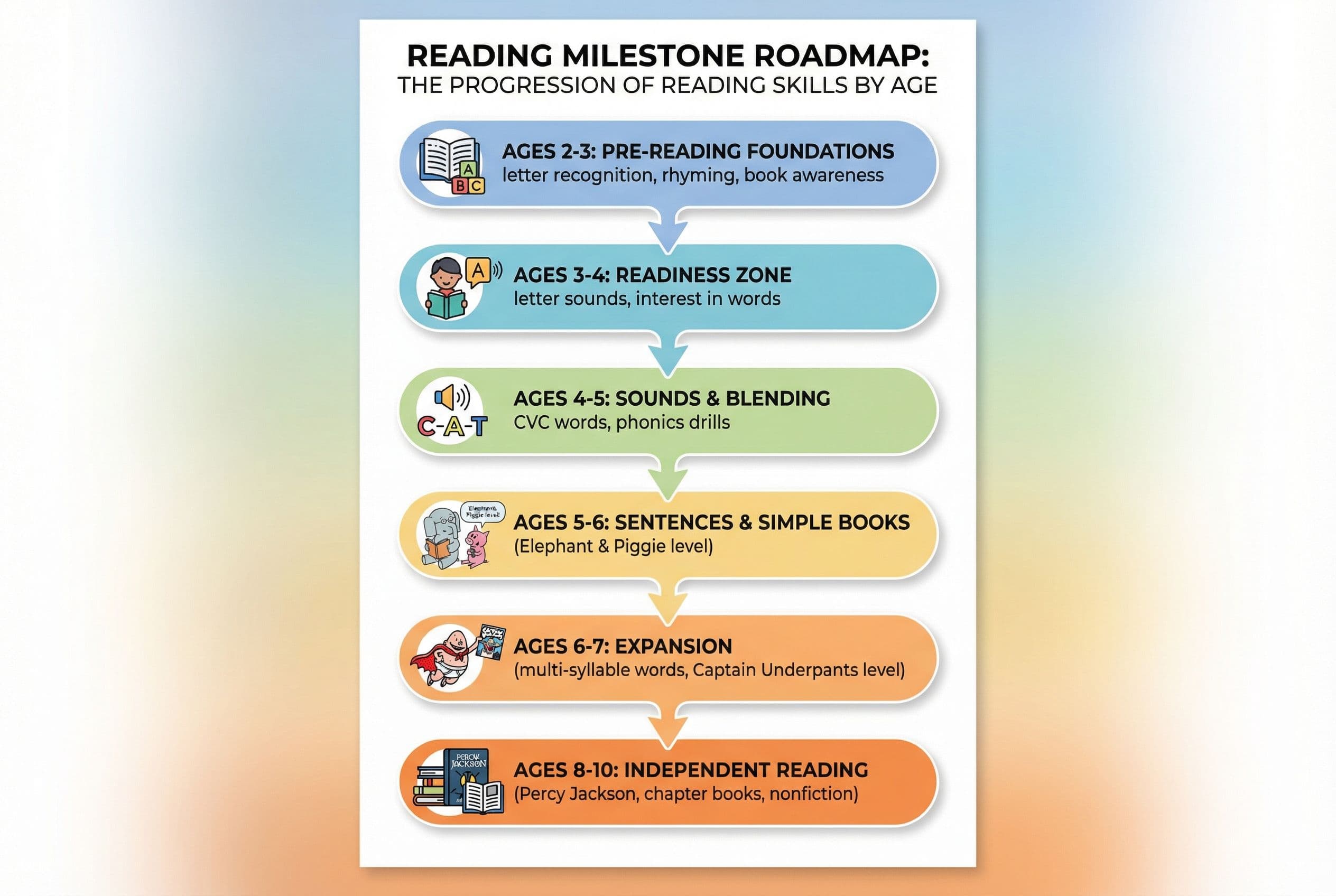
OK so here's what you really came for. Let me walk you through what reading milestones by age actually look like — not from a textbook, but from my kitchen table.
Every kid moves through these stages. Some fly through them. Some camp out at one stage for what feels like forever (trust me on this). The order matters way more than the age.
Quick overview:
| Age Range | Stage | Key Skills |
|---|---|---|
| 2–3 | Pre-reading foundations | Letter recognition, rhyming, book awareness |
| 3–4 | Readiness zone | Letter sounds, interest in words, phonemic awareness |
| 4–5 | Learning sounds & blending | Phonics instruction, CVC words, early sight words |
| 5–6 | Sentences & simple books | Decodable books, fluency building, independent reading |
| 6–7 | Expansion | Multi-syllable words, reading for pleasure, comprehension |
| 8–10 | Independent reading | Chapter books, genres, reading across subjects |
Now let me break each one down.
Ages 2-3: Pre-Reading Foundations
At this age, you're not teaching reading. You're building the foundation for reading.
- Letter recognition: Can they identify some letters? Not all 26 — that's a lot. But exposure matters.
- Book awareness: Do they know how to hold a book? Do they turn pages (roughly) in the right direction?
- Vocabulary building: Are they hearing lots of words? Conversations, read-alouds, songs.
- Rhyming and sound play: Nursery rhymes, silly songs, Dr. Seuss — this is phonological awareness (the big-picture ability to hear and play with sounds in language), and it's a big deal.
Now, some parents go full-send here and start teaching their 2-year-old to read. And look, I'm not saying don't do it. Some kids are ready. But here's my honest take: a lot of those early readers have limited comprehension of what they're decoding. They're not reading stories. They're reading out loud. There's a difference.
A 2-year-old who can decode "The cat sat on the mat" but doesn't understand the story? Decoding alone isn't the whole goal — comprehension is what makes it real reading.
You need to do what's right for you, your child, and your family. But at this stage, the no-brainer move is read-alouds. Read to them every single day. Multiple times a day if you can. That's the foundation everything else builds on.
Ages 3-4: The Readiness Zone
This is where you start watching for reading readiness signs. Not forcing. Watching.
- Letter-sound knowledge: Can they tell you what sound a letter makes, not just its name?
- Interest in words: Are they pointing at signs, labels, their name on their cubby?
- Attention span: Can they sit for a 5-10 minute activity without melting down?
- Phonemic awareness: This is a sub-skill of phonological awareness — it's about individual sounds. Can they hear that "cat" and "bat" rhyme? Can they tell you the first sound in "dog"?
If you're seeing these signs? Start. Gently, consistently, but start.
If you're not seeing them? Keep reading aloud, keep exposing them to letters and sounds, and check again in a month. Don't panic. My second daughter showed almost no interest at 3.5 — and then something clicked at 4 and she blew through the early stages faster than her older sister did.
Ages 4-5: Learning Sounds and Blending (Where Phonics Begins)
This is where real phonics instruction typically begins. And honestly? This is where I am right now with my 4-year-old.
Kids at this stage are:
- Learning individual letter sounds — all 26, plus common digraphs (sh, ch, th)
- Starting to blend sounds together into single-syllable words (CVC words like "cat," "hop," "sit")
- Building sight word recognition for high-frequency words that are irregular or haven't been taught yet by their current phonics patterns ("the," "was," "said") — though plenty of common words are decodable once kids learn the rules
I had my 4-year-old practicing CVC words at the kitchen table last Tuesday. She got "hat" right, then looked at "pig" and said "dog" because there was a dog in the picture on the flashcard next to it. Classic guessing. I covered the picture. "Sound it out," I said. She did. /p/ /i/ /g/. "Pig!" And her face lit up.
That's the magic moment. When they realize they can figure out an unknown word by themselves, without guessing. That's reading.
Quick note on pictures: pictures are great for building language and comprehension — talking about what's happening in a story, making predictions, building vocabulary. But they're terrible for figuring out unknown words. That's what phonics is for. Don't let your kid use the picture as a crutch to avoid sounding it out.
This stage takes patience. Real talk — it's the hardest part. Some days my daughter nails every word. Some days she acts like she's never seen the letter B in her life. That's normal.
Ages 5-6: Sentences and Simple Books
Once blending clicks, things start moving faster.
- Reading simple sentences — "The dog sat on the log."
- Tackling short decodable books where every word uses phonics patterns they've learned
- Building fluency — moving from painful, sound-by-sound decoding to smoother reading
- Graduating to simple stories on their own — decodable readers first, then books like Elephant and Piggie by Mo Willems for motivation and fluency practice
Standards vary across districts and curricula, but here's what I think matters: by the end of this stage, your child should be able to pick up a simple book and read most of it without your help. Not perfectly. Not fast. But independently. Whether your kid is in public school, private school, or homeschooled — the milestone is the same.
And here's where the "is my child ready to read" question shifts. They're not just ready anymore. They're doing it. Your job now is to keep the momentum going.
Ages 6-7: The Expansion
This is where it gets fun. For real this time.
- Multi-syllable words — they're breaking bigger words into chunks and tackling them
- Reading for pleasure — they're choosing books on their own
- Progressing through book levels — from picture books to early graphic novels and comic books
- Growing comprehension — they're not just decoding, they're understanding, predicting, reacting
My 7-year-old lives in this stage right now. She graduated from Elephant and Piggie to Dog Man (which is basically a comic book, and I'm fine with it because she's reading). She's starting to eye the Captain Underpants books on the shelf — longer stories with pictures, more text per page.
The progression is picture books → comic books and graphic novels → longer illustrated stories like Captain Underpants → chapter books with only a picture or two per chapter → full novels with no pictures like Percy Jackson.
That progression doesn't happen in a week. It happens over years. And it only happens if you keep feeding them books and keep the reading habit alive.
Ages 8-10: Independent Reading Takes Off
- Chapter books with minimal illustrations — Magic Tree House, Diary of a Wimpy Kid
- Eventually, books with no pictures at all — Percy Jackson, Harry Potter
- Reading across genres — fiction, nonfiction, magazines, anything they can get their hands on
- Reading the classics — and eventually nonfiction, which is a whole different skill set
My oldest is 10 and she reads everything. Fiction, nonfiction, the back of shampoo bottles. She reads in the car. She reads at breakfast. She reads when she's supposed to be doing math. (Tiger mom problems.)
That didn't happen by accident. It happened because we started early, we were consistent, and we pushed through the hard parts.
The Question You Need to Ask Yourself
Here's what nobody talks about when they ask "what age do children learn to read."
It's not just about when your kid is ready.
It's about when YOU'RE ready.
Because teaching your child to read is a commitment. It's a year — sometimes more — of daily practice. Of frustration. Of your kid melting down because they can't remember the difference between "b" and "d." Of you wondering if you're doing it wrong. Of skipping exactly zero days because that's the rule in this house. Birthdays, Christmas, vacation — we never skip.
When a kid should learn to read comes down to when you think they're ready and when you think you're ready for a year or so of frustration.
But here's what I promise you: once that year is over, it will all be worth it when you see them snuggling up in a corner with a good book.
I remember the first time I caught my oldest curled up on the couch, completely lost in a book, turning pages without asking me for help. I cried. Literally stood in the hallway and cried. All those hard mornings at the kitchen table. All those "I can't do it" meltdowns. All those times I wanted to just turn on a cartoon and give us both a break.
Worth it. Every single second.
A Pre-Reading Skills Checklist (So You Stop Guessing)
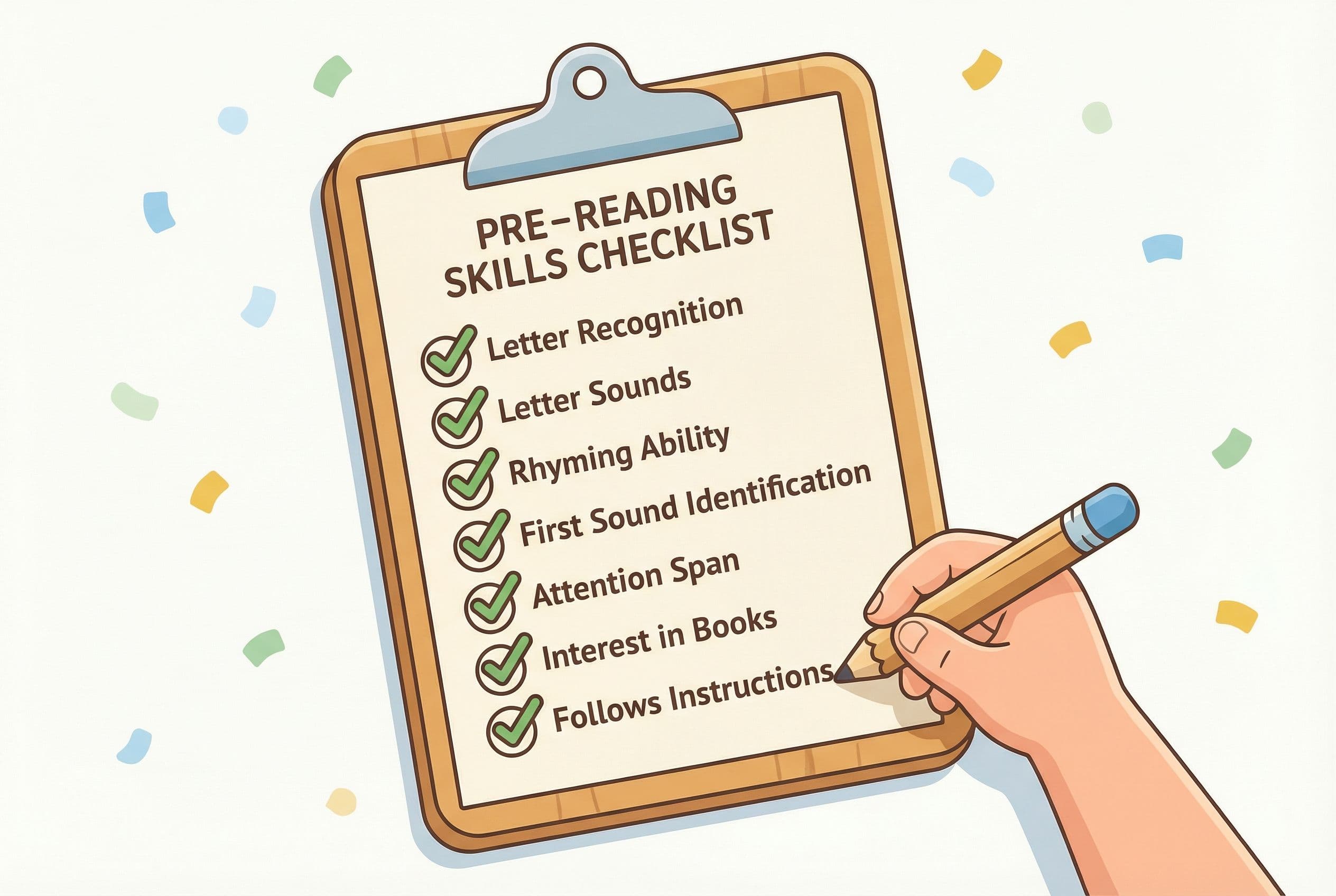
Here's a quick pre-reading skills checklist. If your child can do most of these, they're showing reading readiness signs and you should start phonics instruction:
- ✅ Recognizes most uppercase and lowercase letters
- ✅ Knows at least 15-20 letter sounds
- ✅ Can rhyme (tells you "cat" and "hat" sound the same)
- ✅ Can identify the first sound in a spoken word ("What sound does 'ball' start with?")
- ✅ Can sit and focus on a structured activity for 5-10 minutes
- ✅ Shows interest in words, letters, or books
- ✅ Can follow simple multi-step instructions
If your child hits 5 or more of these? Go. Start. Don't wait for some perfect moment.
If they're hitting 2 or fewer? Spend a month on letter sounds and read-alouds, then check again.
How Teach Your Kid to Read Makes This Easier
Look, I know what I just described sounds like a lot. A year of daily practice? Milestones? Checklists? Where do you even start?
That's exactly why we built our parent-guided phonics program. It's not an app that babysits your kid, but a structured system that tells you exactly what to teach, in what order, every single day.
Here's how it works:
- You start with letter sounds — the program introduces them in a specific, research-backed sequence
- Your child blends sounds into words — with you sitting right there, guiding them, not an algorithm
- You progress through decodable reading — real sentences and stories that use only the sounds they've learned
- Mastery before moving on — no skipping ahead, no guessing, no "close enough"
The whole thing is built on the science of reading. Systematic phonics. No guessing from pictures. No whole-language nonsense where kids memorize word shapes and hope for the best. And it works whether your kid is in public school, private school, or learning at home.
And because it's parent-guided, you're right there for every breakthrough. Every "I did it!" moment. Every time their face lights up because they sounded out a word all by themselves.
You are your child's best teacher. Not a screen. Not an algorithm. You.
Your Action Plan: Start This Week
Here's exactly what to do, no matter where your child is right now.
If your child is 2-3:
- Read aloud for 15-20 minutes every day. No exceptions.
- Sing the alphabet song. Point to letters on signs, books, and cereal boxes.
- Play rhyming games. "What rhymes with 'cat'?" Make it silly.
- Don't stress about formal phonics yet. Build the love of books first.
If your child is 3-4:
- Start teaching letter sounds (not just letter names). "This is the letter S. It says /sss/."
- Run through the pre-reading skills checklist above. Note where they are.
- If they're showing readiness signs, begin a structured phonics program like Teach Your Kid to Read.
- Keep reading aloud every single day. This never stops.
If your child is 4-5:
- Begin daily phonics practice. 10-15 minutes. Every. Day.
- Start blending CVC words. "C-A-T. What word is that?"
- No guessing from pictures. Cover the pictures if you have to.
- Celebrate every win. High-fives. Stickers. Whatever motivates them.
If your child is 5-6 and not reading yet:
- Don't panic, but don't wait either. Start phonics instruction today.
- Check for gaps — do they know their letter sounds? Can they blend? Find where the breakdown is.
- Get a structured program and commit to daily practice.
- Talk to your pediatrician if you suspect a learning disability. Early intervention is everything.
If your child is 7+ and struggling:
- Act now. The 3rd Grade Cliff is coming.
- Get an assessment — from the school, a tutor, or a reading specialist.
- Start intensive phonics instruction. Go back to basics if needed.
- Reach out to us for a catch-up plan — we can help you build one.
The Big Picture: From Sounds to Stories to a Love of Reading
Going from learning sounds to learning to love reading is a progression every kid should experience. But many don't get to.
Some don't get to because their parent doesn't make time for them. Some don't because their school uses a broken curriculum. Some don't because nobody told their mom or dad that this was their job — that the school alone wouldn't be enough.
But if you're reading this? You're not that parent. You care enough to search for answers. You care enough to read 2,000 words from a slightly intense homeschooling mom on the internet. And that tells me you're the kind of parent who will find the time to teach your child to read.
Because you know it's not just about succeeding at life. A kid who can read doesn't just get better grades and better job prospects (though they do). A kid who can read has an entire world opened up to them. Adventures. Knowledge. Empathy. Imagination.
And honestly? Watching your child discover that world — watching them go from sounding out "c-a-t" to devouring Percy Jackson under the covers with a flashlight — that's one of the best things about being a parent.
So start where you are. Use the milestones as a guide, not a prison. Push when they're ready. Wait (briefly) when they're not. And never, ever skip a day.
FAQs
What age should a child learn to read?
There's no single "right" age. Most kids begin formal phonics instruction between ages 4-6, but readiness varies widely. Some kids are ready at 3, others at 6. What matters more than the age is that you start when your child shows readiness signs — knowing letter sounds, rhyming, showing interest in words — and that YOU'RE ready to commit to daily practice for about a year. Don't use "every child is different" as an excuse to do nothing, but don't force a 2-year-old to decode words they can't comprehend either.
What are the signs my child is ready to read?
Key reading readiness signs include:
- Recognizing most letters
- Knowing many letter sounds (not just names)
- Being able to rhyme
- Identifying the first sound in a word
- Focusing on a structured activity for 5-10 minutes
- Showing interest in words and books
If your child checks most of those boxes, start phonics instruction. If they check only one or two, spend a month building those skills and reassess.
Is it bad to teach a 3-year-old to read?
Not bad — but be honest about what you're actually accomplishing. A 3-year-old who can decode words out loud but has limited comprehension of what they're reading isn't really "reading" in the fullest sense. They're performing a skill without full understanding. If your 3-year-old is genuinely interested and you're having fun with it, go for it. But don't push phonics drills on a toddler who'd rather stack blocks. Build the foundation — read-alouds, letter sounds, rhyming — and start formal instruction when they're truly ready.
What reading level should my child be at in kindergarten?
Kindergarten reading level expectations vary by state and school, but a reasonable target by the end of kindergarten is: your child can decode simple CVC words (cat, dog, sit), read short decodable sentences, recognize common sight words (the, is, and), and understand basic story elements from read-alouds. Some kids will be further ahead, some behind. The key is consistent progress, not hitting an arbitrary benchmark on an arbitrary date.
My child is 7 and still can't read. Should I be worried?
Yes — but worried enough to act, not worried enough to panic. A 7-year-old who can't read is behind, and the 3rd Grade Cliff is approaching fast. Start intensive phonics instruction immediately. Go back to basics — letter sounds, blending, CVC words — even if it feels like "going backward." Consider an assessment for learning disabilities like dyslexia. And reach out to us at Teach Your Kid to Read — we can help you build a catch-up plan. The earlier you intervene, the faster they'll progress.

Xia Brody
Co-Founder, Teach Your Kid to Read
Mom of 4 who has successfully taught her kids to read. Currently in the trenches with her 4-year-old while her two oldest (10 and 7) devour books on their own. Passionate about phonics-based methods and building a lifelong love of reading.