Word Families for Kids: Rhyming Patterns That Accelerate Reading
What You'll Learn
- The one phonics shortcut that lets your kid decode dozens of new words from a single pattern (and why most parents overlook it)
- Why rhyming isn't just cute — it builds the phonological awareness that supports real decoding, and how to use it every single day without sitting at a desk
- The word family list beginning readers actually need (not the bloated 200-item lists floating around Pinterest)
- The mistake that turns word families into another guessing game — and how to make sure your kid is actually reading, not memorizing
Your Kid Is Drowning in Words. Here's Why.
Picture this. Your 4-year-old sits down with a simple book. Page one: "The cat sat on the mat." She sounds out C-A-T. Beautiful. Then she hits S-A-T. Full stop. Deer in headlights. She starts the whole painful sounding-out process from scratch like she's never seen those letters before.
She just read "-at" ten seconds ago. But she doesn't know that "-at" is a pattern — a chunk she can reuse. So every single word feels brand new. Every single word is a mountain.
This is what happens when kids learn letter sounds but nobody teaches them to see the patterns between words. They've got the raw material but no system. It's like having all the LEGO bricks but no idea they snap together.
Word families for kids fix this. Fast.
The Tiger Truth: What Happens When You Don't Teach Patterns
Here's what I've watched happen — not in theory, in real life, at real kitchen tables.
A kid learns all 26 letter sounds. The parents celebrate. (They should! That's great!) But then the kid stalls. Hard. Because sounding out each word from scratch, every single time, is exhausting. It's like trying to do long division when you haven't memorized your times tables.
Know what the worst part is? The kid starts guessing. She sees the picture of a cat on a mat and says "rug" instead of "mat." She's not reading anymore — she's playing a matching game with pictures. And nobody corrects her because, hey, she got close, right?
Wrong. "Close" isn't reading. "Close" is the beginning of a habit that will follow her to 3rd grade, where there are no more pictures to guess from and the 3rd Grade Cliff swallows kids whole.
The research is brutal: according to a well-known study by the Annie E. Casey Foundation, kids who can't read proficiently by the end of 3rd grade are far more likely to drop out of high school — with some subgroups facing up to four times the risk. That stat keeps me up at night.
But here's the thing — word families are one of the simplest, most effective tools to keep your kid off that cliff. And you don't need a teaching degree. You need about 15 minutes a day and a willingness to be annoying about it.
What Are Word Families, Exactly?
A word family is a group of words that share the same ending sound pattern. That's it. No fancy jargon needed.
Take the -at word family: cat, bat, hat, mat, sat, rat, fat, pat, flat.
Once your kid truly knows the "-at" chunk — not just recognizes it, but can hear it, see it, and produce it automatically — she doesn't have to sound out three individual letters for every new word. She sounds out the first letter and snaps on the ending she already owns.
B + at = bat. H + at = hat. S + at = sat.
See how that works? One pattern. Nine words. Instantly.
One big caveat here: your kid should be able to decode each word sound-by-sound first before you let her treat the rime as a shortcut chunk. If she can't read "cat" by blending /c/ + /a/ + /t/, don't let her read "bat" by pattern alone — that's just trading picture-guessing for chunk-guessing. The pattern becomes a speed boost after she can already decode the sounds. Not before.
Now multiply that across 20-30 common word families, and your kid has access to hundreds of words. Not by memorizing each one individually, but by mastering reusable chunks.
This is the difference between handing your kid a fish and teaching her to fish. (Sorry for the cliché, but it's accurate.)
The Word Family List Beginning Readers Actually Need
I've seen word family lists online with 50, 60, even 80 families. That's insane for a beginning reader. Your 4-year-old doesn't need 80 families. She needs 15-20 solid ones, mastered cold.
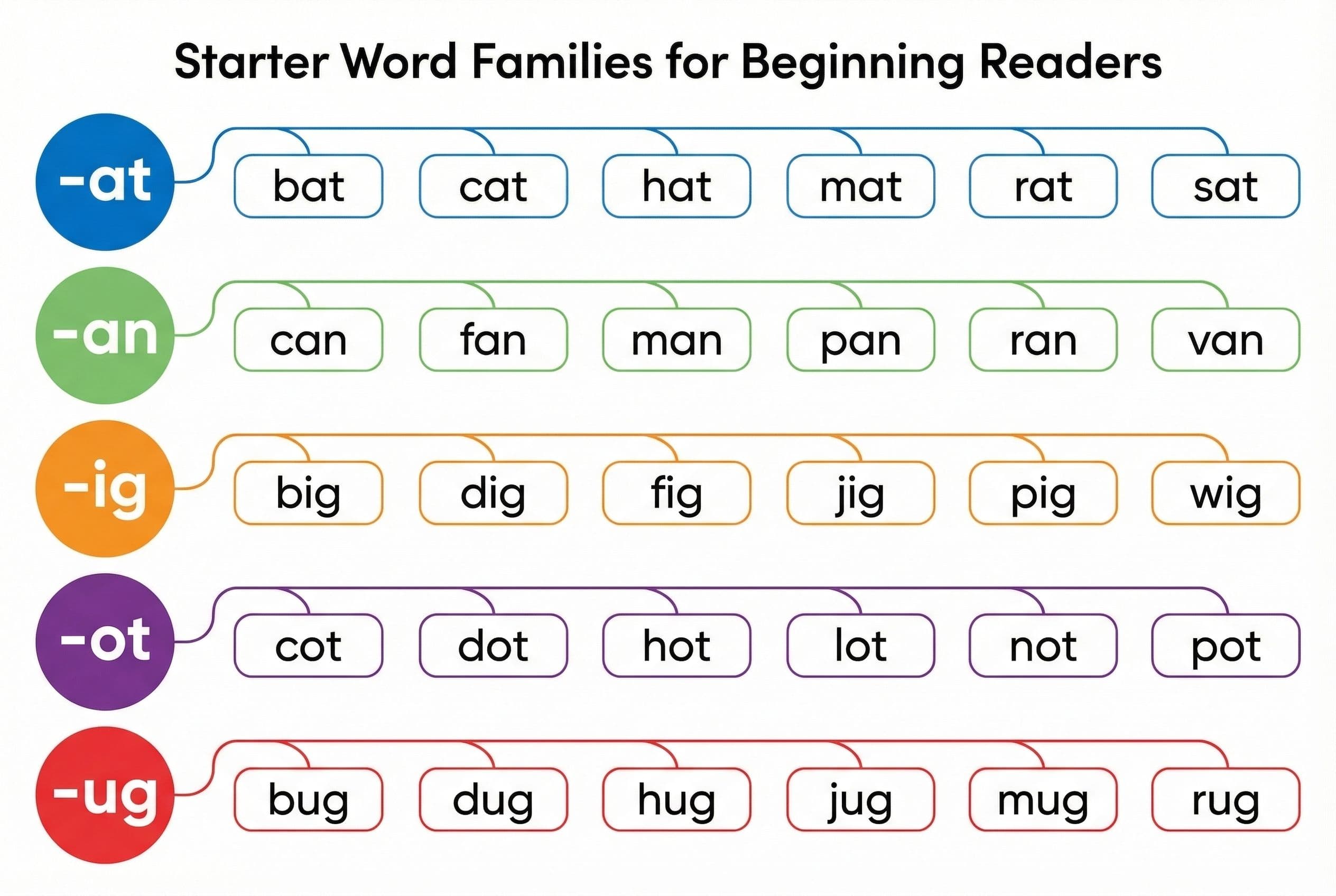
Here are the word families I start with — the ones that give you the biggest bang for your buck because they show up constantly in early reading material:
Tier 1: Start Here (Short Vowel CVC Families)
- -at: cat, bat, hat, mat, sat, rat, pat, flat
- -an: can, man, fan, pan, ran, van, tan, plan
- -ap: cap, map, nap, tap, lap, clap, snap
- -am: ham, jam, ram, yam, clam, slam
- -ag: bag, tag, rag, wag, flag, drag
- -ig: big, dig, fig, pig, wig, twig
- -in: bin, fin, pin, win, thin, grin
- -it: bit, fit, hit, kit, sit, spit, quit
- -ip: dip, hip, lip, rip, tip, zip, chip, skip
- -ot: cot, dot, got, hot, lot, not, pot, spot
- -op: cop, hop, mop, pop, top, chop, drop, stop
- -og: bog, dog, fog, hog, jog, log, frog
- -ug: bug, dug, hug, jug, mug, rug, plug, slug
- -un: bun, fun, gun, run, sun, spun, stun
- -ut: but, cut, gut, hut, nut, shut, strut
Tier 2: Add These Once Tier 1 Is Solid
- -ed: bed, fed, led, red, shed, sled
- -et: bet, get, jet, met, net, pet, set, wet
- -en: den, hen, men, pen, ten, then, when
- -ack: back, pack, rack, sack, black, crack, stack, track
- -ick: kick, lick, pick, sick, thick, trick, stick, quick
Don't rush through these. Mastery means your kid can read any word in the family without hesitation. Not "mostly gets it." Not "gets it right with a hint." Cold. Automatic. No guessing.
The Grocery Store Is Your Classroom (Seriously)
OK so here's where I'm going to say something that might sound weird but is hands down the best advice in this whole article.
Play rhyming games everywhere you go.
I'm not talking about sitting at a desk with worksheets. I'm talking about the grocery store. The car. The park. The walk to the mailbox. Anywhere you're already spending time with your kid.
Here's the deal with rhyming: it trains your kid's ears to hear the patterns in words. That's phonological awareness — the ability to notice that "cat" and "hat" and "mat" all end the same way. Rhyming helps their ears; phonics teaches their eyes. You need both. The ear training makes the on-the-page decoding click faster, because when your kid sees the -at pattern, she already knows what that sounds like from all those rhyming games.
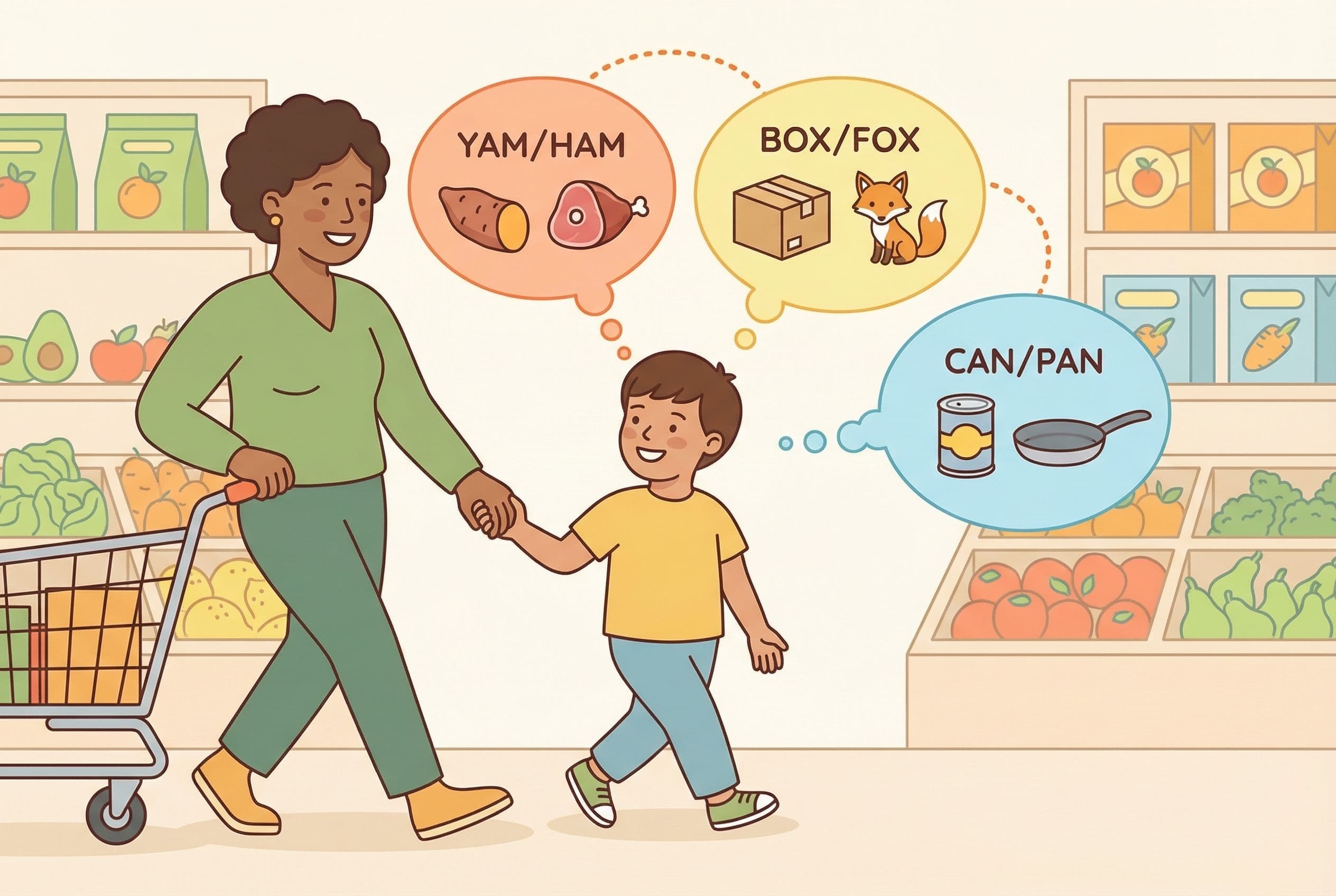
Here's what this looks like in real life. You're pushing the cart through the produce section. You pick up a yam.
"Hey, what rhymes with yam?"
"Ham!"
"Nice. What else?"
"Jam! Clam! Sam!"
"Sam isn't a real rhyme — oh wait, yes it is. You got me."
That took 20 seconds. No flashcards. No app. No screen. Just you and your kid and a yam. And she just practiced the -am word family without even realizing it.
I do this constantly. In the cereal aisle: "What rhymes with box?" At the deli counter: "What rhymes with ham?" Walking past the pet food: "What rhymes with dog?" My 4-year-old thinks it's hilarious. He shouts the answers. Other shoppers stare. I don't care.
The kicker is that this kind of everyday rhyming practice solidifies what they've already been learning during structured phonics time. The flashcards and the worksheets build the foundation. But the grocery store rhyming game? That's where the ear training locks in. That's where the pattern stops being something they do at the kitchen table and becomes something they own.
Make it a habit. Every regular errand you run together becomes a word family workout. Walking to the car: "What rhymes with sun?" Waiting at the doctor's office: "What rhymes with sit?" Brushing teeth: "What rhymes with brush?" (OK, that one's harder. But you get the idea.)
Your kid will start doing it back to you. That's when you know it's working.
How I Actually Teach Word Families (Step by Step)
I'm going to give you the exact process I use. This is what I did with my daughter Lian, and it's what I'm doing right now with my 4-year-old.
Quick context: Lian went from zero letter sounds at age 4 to reading simple chapter books by age 6. Not because she's some prodigy — she's not. She's a normal kid who would rather play with slime than sit down with a book. But we did phonics practice every single day. Birthdays, Christmas, vacation. My husband thought I was losing my mind. Other parents at the park would give me looks when I'd pull out flashcards between the swings and the slide.
She's 7 now and reads for fun. Actual fun — she'll curl up with a book instead of asking for the iPad. And every single parent who judged me for the flashcards-at-the-park thing has since asked me how I did it. The answer is boring: consistency. Every. Single. Day.
Word families were a huge part of that consistency. Here's the step-by-step:
Step 1: Make Sure Letter Sounds Are Solid First
Don't start word families until your kid knows her letter sounds — not letter names, letter sounds. She needs to hear "b" and say /b/, not "bee." If she can't do that automatically for at least 20 of the 26 letters, go back and drill letter sounds first.
I use our Teach Your Kid to Read app for this part because the spaced repetition is built in and I don't have to track what she's mastered myself. our reading programs
Step 2: Introduce One Family at a Time
Pick a single word family. I usually start with -at because the words are common, the vowel sound is clear, and kids love cats.
Write these on index cards or a whiteboard:
cat — bat — hat — mat — sat — rat
Point to the "-at" ending in each word. Say it out loud: "These all end in -at. See? C-at. B-at. H-at. The ending is always the same. Only the first letter changes."
Have your kid read each word. If she struggles, don't let her guess. Sound it out: the first sound, then snap on the "-at."
Important: For the first few words in any new family, have her sound out every single letter — /c/ + /a/ + /t/ — not just the onset and the chunk. Once she can do that accurately and consistently, then let her use the rime as a shortcut. If she can't read "cat" sound by sound, she's not ready to snap "b" onto "-at" and call it reading. That's just guessing with a fancier hat on.
Step 3: Drill Until It's Automatic
This is where most parents quit. They introduce the family, the kid reads the words once or twice, and they move on. No.
Your kid needs to read those words so fast that there's zero hesitation. I use a "speed round" — I hold up flashcards and she reads them as fast as she can. We time it. She tries to beat her own record. She loves this (competitive kid — wonder where she gets it).
Do this for 3-5 days on the same family before introducing a new one.
Step 4: Mix Families Together
Once your kid knows two families — say, -at and -an — mix the flashcards together. This is where you find out if she's actually reading or if she memorized the order.
If she sees "man" and says "mat," she's not reading the word. She's guessing based on the first letter. Go back and drill the endings separately, then mix again.
Step 5: Take It Off the Page
This is the grocery store step. The car ride step. The everywhere-you-go step.
Once she's solid on a word family at the table, take the rhyming game into real life. "What rhymes with cat?" at the pet store. "What rhymes with hop?" while she's literally hopping. The goal is to make the pattern so deeply ingrained that she doesn't have to think about it.
Step 6: Add Families Gradually
One new family per week is a solid pace for most kids. Some will move faster. Some slower. Don't compare your kid to anyone else's. The pace doesn't matter. The consistency does.
Word Family Activities That Actually Work (Not Just Cute Crafts)
Look, I've seen the Pinterest boards. Word family rainbows. Word family houses made of construction paper. Word family sorting games with cute little illustrations.
Some of those are fine. But let me be real — the activity that moves the needle the most is not the cutest one. It's the one your kid does every day.
Here are word family activities I've actually used and seen results from:
1. Flashcard Speed Rounds
I already mentioned this. Write each word on an index card. Shuffle. Time your kid. Beat the record. Five minutes. Done.
2. Word Building with Magnetic Letters
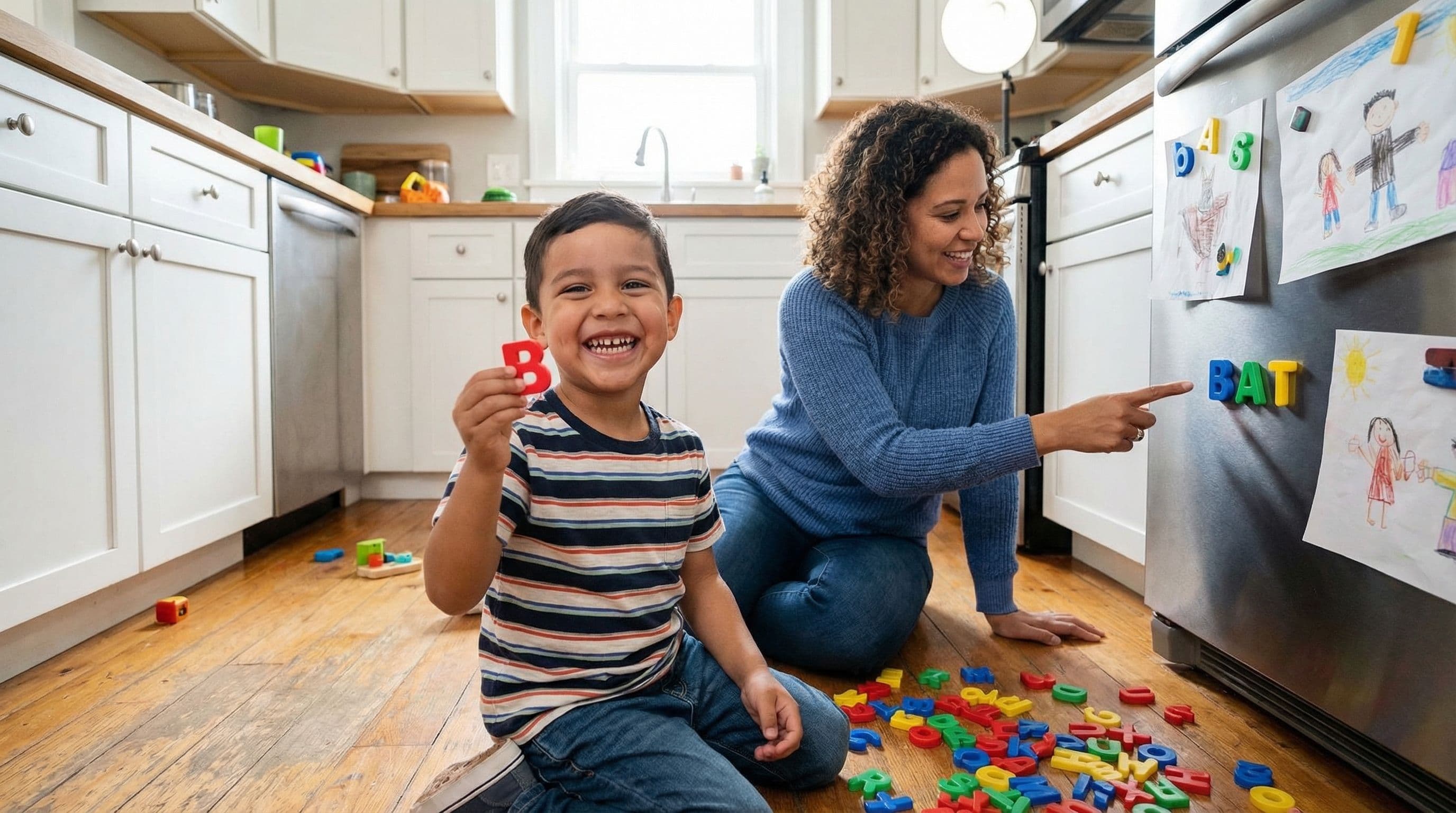
Stick the "-at" chunk on the fridge. Hand your kid a pile of consonant magnets. "How many words can you build?" She swaps out the first letter over and over. B-at. C-at. H-at. She's physically building the words, which helps kinesthetic learners especially.
3. The "Silly Sentence" Game
Once your kid knows a few words in a family, challenge her to make the silliest sentence using as many as she can. "The fat cat sat on a bat with a hat." She'll giggle. She'll also be reading six words from the same family in context.
4. Rhyming Scavenger Hunt
Pick a word family. Walk around the house (or the store, or the park). Find things that rhyme with it. -ug family? Find a mug, a rug, give someone a hug. Real objects, real words, real practice.
5. CVC Word Family Games in the App
Teach Your Kid to Read has built-in CVC word family games that reinforce exactly what you're doing at home. The app handles the repetition and progression so you can focus on the real-life rhyming and the daily practice. our reading programs
The Mistake That Turns Word Families Into a Guessing Game
This one drives me crazy.
Some programs teach word families by showing the word next to a picture. The kid sees "cat" next to a picture of a cat. Then "hat" next to a picture of a hat. Seems helpful, right?
It's not. Here's why.
The kid starts looking at the picture instead of the letters. She sees the picture of a dog next to "dog" and reads it correctly — but she didn't actually decode anything. She looked at the picture and said the word. That's not reading. That's labeling.
Then she hits a word with no picture, and she's stuck.
And here's the sneakier version of the same trap: chunk-guessing. Your kid sees "-at" and blurts out "cat" without even looking at the first letter. She recognized the pattern but skipped the actual reading part. If she's saying "cat" when the word is "bat," she's not decoding — she's guessing from the chunk. Same problem, different disguise.
No guessing. No pictures as crutches. No skipping the first letter. Sound it out.
When you practice word families, use plain text. No illustrations next to the words. If your kid gets stuck, don't give hints. Don't say "it rhymes with cat." Point to the letters. "What sound does this make? Good. Now what's this chunk? Put them together."
It's slower. It's harder. It's right.
When Should You Start Teaching Word Families?
Most kids are ready for word family work between ages 4 and 5, after they've mastered letter sounds. Not letter names. Sounds.
Here's a quick readiness checklist:
- ✅ Can identify and produce sounds for at least 20 letters
- ✅ Can blend two sounds together (say /s/ then /a/ — "sa")
- ✅ Can hear rhymes (knows that "cat" and "hat" sound alike at the end)
- ✅ Has the attention span for 10-15 minutes of structured practice
If your kid can do all four, start word families. Today. Not next month. Not "when they seem ready." Today.
If your kid can hear rhymes but doesn't know letter sounds yet, start with our letter sounds program and play rhyming games in the meantime. Those grocery store rhyming sessions I talked about? You can do those right now, even before your kid knows a single letter. You're building the auditory foundation she'll need when she does start decoding.
Real Talk: Why "Fun" Isn't the Goal
I hear parents say this all the time: "I just want reading to be fun for my kid."
I get it. I do. Nobody wants to watch their kid cry over flashcards.
But here's what I've learned from teaching three kids (so far): mastery is what's fun. The fun doesn't come from glitter glue and themed worksheets. The fun comes from your kid reading a word on a cereal box and her face lighting up because she did it herself.
The rhyming games at the grocery store? Those are fun. Genuinely. My kids laugh, they get competitive, they shout out ridiculous made-up rhymes. That part is a blast.
But the 10 minutes of drilling flashcards at the kitchen table? Not always fun. Sometimes my 4-year-old whines. Sometimes he tries to negotiate his way out of it. We do it anyway.
Because the payoff — the moment he reads "The dog sat on the log" all by himself and looks up at me with those huge eyes — that's the real fun. And it only happens because of the boring, consistent, daily work that got him there.
Frequently Asked Questions
How many word families should a kindergartner know?
By the end of kindergarten, most kids should be comfortable with 15-20 short vowel word families. That covers the major CVC patterns and gives them enough decoding power to read simple sentences and early readers. Don't worry about hitting a specific number — worry about whether the families they do know are mastered cold. Five families with full mastery beats 20 families with shaky recall.
What's the best word family to start with?
The -at word family is my go-to starting point, and most reading specialists agree. The words are common (cat, hat, sat, mat), the short /a/ vowel sound is one of the clearest for young ears, and you can build silly sentences immediately. After -at, I move to -an, -ap, or -ig depending on what the kid responds to.
Can I teach word families to a 3-year-old?
You can absolutely play rhyming games with a 3-year-old. Grocery store rhyming, silly rhyming at bath time, singing nursery rhymes — all of that builds the phonological awareness your 3-year-old needs. But formal word family instruction (reading the words on the page) usually works better around age 4-5, after letter sounds are solid. Play the rhyming games now. Start the decoding work when the letter sounds are in place.
How long should word family practice take each day?
10-15 minutes of structured practice at the table, plus as many "bonus" rhyming moments throughout the day as you can squeeze in. The grocery store game, the car ride game, the bath time game — those don't feel like practice to your kid, but they reinforce everything. Don't marathon it. Short, daily, consistent sessions beat a 45-minute weekend cram every time.
What if my kid keeps confusing word families that look similar?
This is totally normal, especially with families like -at and -an, or -it and -in. When this happens, go back to drilling the two confusing families separately for a few days. Then mix them together in a sorting activity — have your kid put -at words in one pile and -an words in another. Say the ending chunk out loud every time. The auditory practice is what locks it in. Don't skip ahead until the confusion is resolved. Patience now prevents guessing habits later.

Xia Brody
Co-Founder, Teach Your Kid to Read
Mom of 4 who has successfully taught her kids to read. Currently in the trenches with her 4-year-old while her two oldest (10 and 7) devour books on their own. Passionate about phonics-based methods and building a lifelong love of reading.